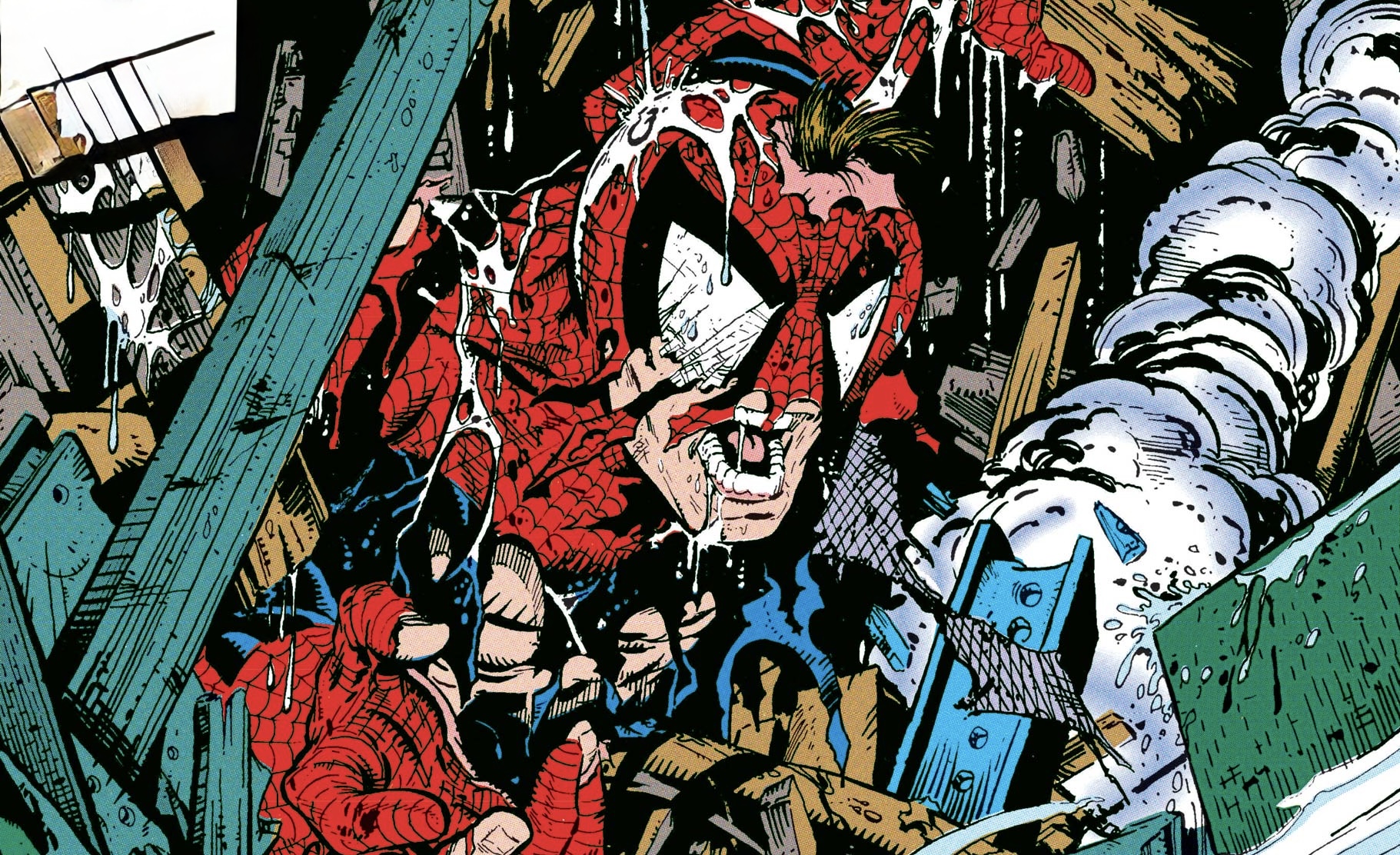
Story from the Vault
Three Million People Bought Todd McFarlane’s Worst Work. He Told Them So. (1990)
27 June 2026 · Marvel
The record-breaking Spider-Man arc that built Image Comics was, by its own creator’s admission, barely a story. That tension has never been properly reckoned with.
Peter Parker nearly dies five times across five issues. His wife goes dancing.
That’s it. That’s the B-story of Torment.
The 1990 arc that launched McFarlane’s solo Spider-Man title broke sales records that still stand. Mary Jane Watson-Parker spends all five issues at a club, moving to a beat McFarlane vaguely implies is connected to Calypso’s voodoo drumming. There is no payoff. There is no connection made explicit. She goes home. The arc ends.
That detail gets noted, usually as a throwaway criticism before the reviewer pivots back to how good the art looks. It deserves longer than that. Because it tells you something specific about what McFarlane was doing — or more precisely, what he wasn’t. Mary Jane exists in Torment as furniture. A proof of domestic life. Something to cut to when the Lizard needs a scene change. She is written not as a character but as a visual contrast — warmth against darkness, red hair against black panels. That is a visual artist’s logic, not a storyteller’s.
McFarlane said as much himself. By the time Spider-Man #1 hit stands, he had years and hundreds of pages of pencilling behind him. The kinks were out of the drawing. The writing kinks were just beginning. “Arguably, the worst story I ever write is going to be the one that most people bought,” he told an interviewer years later. Most creators spend careers avoiding that sentence. McFarlane handed it to an interviewer and moved on. He isn’t embarrassed. He’s almost proud. That tells you more about who he is than the sales figures do — though the sales figures are worth sitting with.
Spider-Man #1 sold somewhere between 2.5 and 3 million copies. At its 2024 peak, Amazing Spider-Man moves around 70,000 copies a month. Readers in 1990 weren’t just buying a comic. They were buying a commodity, a collectable, a futures contract on the idea that Todd McFarlane was going to matter. They were right. They were buying the wrong thing for the right reasons.
What they got was this: the Lizard, stripped entirely of Curt Connors’ personality, sent on a killing spree through New York by Calypso — voodoo priestess, former lover of Kraven the Hunter. Calypso poisons Spider-Man through the Lizard’s claws, then manipulates his mind until he hallucinates Kraven alive and talking. Spider-Man survives. A building explodes. The Lizard is presumed dead and isn’t.
If that premise feels familiar, it should. Kraven’s Last Hunt published in 1987, three years earlier. Written by J.M. DeMatteis, drawn by Mike Zeck, it remains the most psychologically serious Spider-Man story ever committed to paper. Kraven buries Peter alive, assumes his identity, drives himself to the edge, then takes his own life. Torment takes the emotional residue of that story and uses it as atmosphere. The Kraven hallucination is Torment‘s most affecting sequence, and it works precisely because DeMatteis did the heavy lifting three years prior. McFarlane understood what that story had deposited in readers — a specific dread, a raw nerve around Kraven — and he pressed on it. That isn’t homage. That’s a writer finding the room already furnished and sitting down in it.
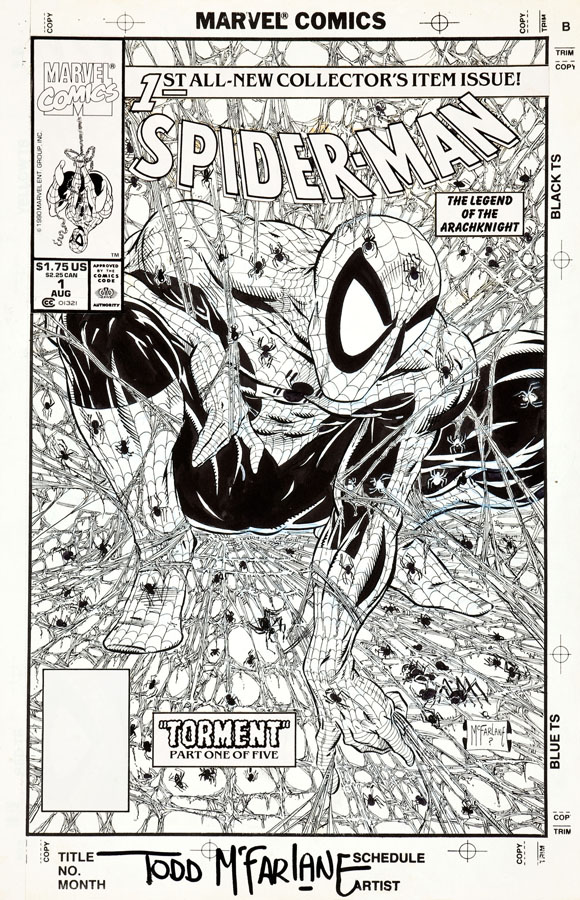
What Torment does establish, without ambiguity, is where McFarlane’s real authority lies. The pages remain startling now. Spider-Man moves through them like something between an athlete and an insect — elongated, angular, never quite comfortable inside a panel’s borders. The Lizard carries a physical menace the character almost never gets; McFarlane gives him weight, shadow, and something close to inevitability. The New York of Torment is not a backdrop. It is a wet, dark, hostile thing. When the poison hits Spider-Man’s system, the page layouts fracture to match it. This is not illustration in service of story. This is illustration as story — and in those moments Torment makes a case for itself that no amount of clumsy narration can undo.
That narration, though. The captions drift between first person, third person, and a second-person address that appears without warning and disappears the same way. Critics then and since have been consistent on this, and they are right. But there is something instructive in the inconsistency. You can watch McFarlane reaching for the register of Frank Miller, finding it briefly, losing it, reaching again. He wanted Torment to feel like serious, adult comics. He’d seen what The Dark Knight Returns had done, what Watchmen had done, what Kraven’s Last Hunt had done. He wanted that gravity. He wanted to be taken seriously in a room that had always valued his hands over his mind. Torment is what that ambition looks like before the craft catches up.
Eighteen months after it published, McFarlane walked away from Marvel and co-founded Image Comics. He built an empire on a book he publicly called his worst work. The art outlasted the writing, the writing outlasted the critics, and the critics outlasted their own certainty about what any of it was worth.
Three million people were there at the beginning. Most of them still have the bag.