Story from the Vault
The Death of Superman (1992)
20 January 2026 · DC Comics
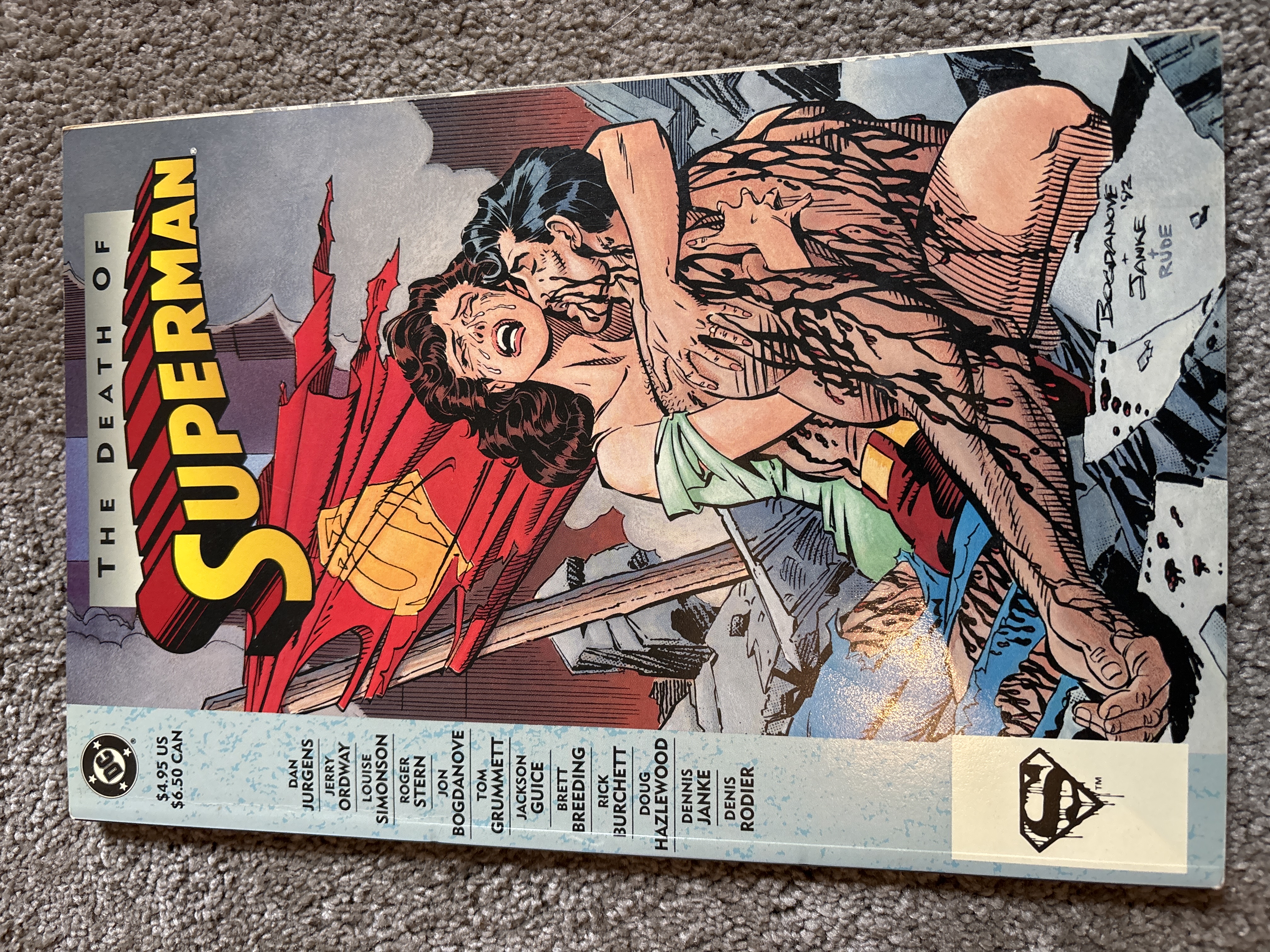
Pick up a copy of The Death of Superman and there is still a faint charge in the thing, even now. Not only because of what happens on the page, though the title leaves little room for coyness, but because so many readers remember the sensation around it. The black polybag. The bleeding S-shield. The news reports that treated a monthly superhero comic as if a national monument had cracked in half. For collectors of a certain age, the book does not merely recall a story. It recalls the day comics briefly walked out of the specialty shop and into the evening news.
That can make it easy to misremember the comic itself as a stunt, all packaging and headlines. Yet the strange durability of The Death of Superman comes from the opposite quality. Beneath the noise is a blunt, almost primitive superhero story about endurance. A monster arrives. It keeps walking. Superman stands in its path because, finally, that is what Superman does. The simplicity is the point, and in the right mood it still lands with the force of a bell struck in a quiet room.
A crossover built for the weekly habit
DC Comics published the storyline across its Superman family of titles in 1992, at a moment when the American comics market was swelling with speculation, variant covers, expanding continuity, and an audience hungry for events that felt too large for a single issue. The core sequence moved through books such as Superman: The Man of Steel, Justice League America, Superman, Adventures of Superman, and Action Comics, before reaching its famous climax in Superman #75. The collected edition that followed gathered the experience into a more permanent object, but the original rhythm mattered. Readers were trained to come back week after week, title after title, as the threat called Doomsday pushed closer to Metropolis.
The storyline arrived during a fascinating period for Superman. DC had rebuilt him after Crisis on Infinite Earths, with John Byrne’s mid 1980s relaunch clearing the ground for a more grounded Clark Kent, a more central Lois Lane, and a supporting cast who lived and breathed with unusual consistency across the line. By the early 1990s, the Superman books operated almost like a television writers’ room. Plot threads passed from one title to another. Character beats accumulated. A reader who followed all of it did not feel that they were buying four separate magazines so much as keeping up with one large, ongoing life.
That structure is crucial to why the death mattered. Superman was not removed from a static world. He was taken from a busy one, full of colleagues, fiancée, parents, rivals, neighbors, and strangers who had come to expect the impossible from him. The machinery of the crossover sometimes shows its age, as all heavily serialized comics do, but the emotional architecture is sound. DC did not ask readers to mourn an idea in the abstract. It asked them to watch a community lose the person at its center.
The Superman office as ensemble craft
The creative team reflected that shared-world approach. Dan Jurgens is the name most immediately associated with the event, not least because he wrote and drew Superman #75, the climactic issue with its increasingly large panels and its final, devastating full-page images. Jurgens brought clean storytelling, a strong sense of physical momentum, and an instinctive understanding of Superman as both mythic figure and working hero. His Doomsday is not complicated, but he is horribly legible. Every torn costume, broken wall, and cratered street tells you what the creature is.
Louise Simonson, writing Superman: The Man of Steel, brought a novelist’s care for emotional pressure and a deep familiarity with young readers and ensemble dynamics. Her comics often understand how fear travels through a group, how a crisis can reveal tenderness without slowing the plot. Roger Stern, on Action Comics, had a long command of classic superhero structure, the kind that can balance spectacle with moral clarity. Jerry Ordway, whose connection to Superman runs through both writing and art, carried an affection for the Daily Planet world and for the warmth around Clark. Karl Kesel, an important inking and creative presence in the Superman line, helped define the polished, muscular look that many readers still associate with the period.
What is striking, looking back, is how coordinated the whole enterprise feels. The story may have been engineered inside a commercial marketplace that rewarded big shocks, but it is not careless. Each chapter has a job. The Justice League goes down early, not because the League is being mocked, but because readers need to understand the scale of the problem. The destruction moves from open spaces toward the city, tightening the dread. Lois and Jimmy follow the story as reporters, which lets the comic keep one foot in human concern even as the punches grow seismic. The creators were not trying to outwit the reader. They were trying to make inevitability hurt.
The last stand, and what it left behind
The plot is famously direct. A mysterious figure breaks free from underground confinement and begins a path of destruction. At first he is a shape in green containment gear, one arm tied behind his back, an image so blunt it almost dares you to laugh. Then the laughter dries up. He tears through obstacles, defeats heroes, and earns a name from Booster Gold after the carnage around him starts to resemble judgment day. By the time Doomsday reaches Metropolis, he has become less a character than a weather system made of fists.
Superman meets him because no one else can. Around that central collision, the supporting cast gives the book its pulse. Lois Lane is not merely the grieving beloved waiting at the edge of the battlefield. She is a professional who understands the public meaning of what is happening before she can bear the private cost. Jimmy Olsen, Cat Grant, Bibbo Bibbowski, the Kents, and the citizens of Metropolis help frame Superman as a presence felt differently by everyone. To some he is a headline. To others he is a friend, a son, a symbol, a man who once stopped long enough to help.
Superman #75 remains the formal centerpiece. Its panel count famously decreases as the issue progresses, giving the battle a grim ceremonial rhythm. The pages seem to inhale, then hold. By the final exchanges, there is no room left for subplot or cleverness. Just impact, exhaustion, and the awful intimacy of Lois holding Clark in the street. The comic knows exactly what image it has been building toward, and it gives that image the space to wound.
The reception was enormous. Mainstream media covered Superman’s death with a seriousness that now feels both charming and surreal, as though the country had briefly agreed to treat fictional continuity as public record. Retailers saw crowds. Collectors bought multiple copies. The black-bagged edition of Superman #75, packaged with extras such as an armband and commemorative material, became one of the defining objects of 1990s comics culture. For many people, it was the first comic they bought as an event rather than as an issue.
Of course, the collector market eventually cooled, and Superman did not stay dead. The following chapters, Funeral for a Friend and Reign of the Supermen, turned the absence into a larger examination of what Superman meant, introducing or foregrounding figures such as Steel, Superboy, the Eradicator, and the Cyborg Superman. Some readers later treated the whole affair as proof that superhero death had become temporary, a revolving door wrapped in foil logos and sales charts. There is truth in that criticism, but it can flatten the original experience. In 1992, the question was not whether corporate comics would resurrect an icon forever. The question, felt by readers in real time, was how it would feel to see the unbreakable man broken.
That is why collectors still chase it in so many forms. Not every copy is rare, and condition matters in the usual ways, especially with sealed editions whose value can depend on completeness and presentation. Yet collectability is not only scarcity. Sometimes it is memory made tangible. A well-kept copy of The Death of Superman, whether as the original issues, the black-bagged Superman #75, or a later collected edition, carries the aura of a moment when comics escaped their own walls. It is a book people bought to preserve a feeling.
Read today, The Death of Superman is at once very 1992 and more resilient than its reputation suggests. The fashions of the time are visible, from the brawny action to the event-driven publishing model, but the emotional line is clean. Superman falls because he refuses to move aside. The world mourns because, for all his power, what people loved in him was his choice to be present. If you have only ever known the storyline as a headline or a collectible in a bag, it is worth opening a reading copy and letting the pages do their quieter work. The old shock may have passed, but the final stand still knows how to find the heart.