Story from the Vault
The Authority: The Superhero Team That Stopped Asking Permission (2013)
12 July 2026 · Dc comics
Launched in 1999 from the ashes of a book almost nobody was buying, The Authority gave the industry widescreen storytelling, a genuinely radical political posture, and the first A-list gay superhero couple. Twenty-seven years on, its DNA is everywhere: in The Ultimates, in the visual language of the MCU, in The Boys, and in the ongoing argument about what superheroes are actually for.
Origins: salvaged from a failure
The Authority didn't arrive fully formed. It was assembled from the wreckage of something else.
In 1996, Warren Ellis took over WildStorm's StormWatch — a Jim Lee-created team book about a UN-funded superhuman black-ops unit — and reshaped it from a standard-issue Image musclebook into something colder and more political. Ellis introduced heroes who were world-weary and morally driven but permanently hamstrung by bureaucrats and budgets, and he leaned hard into the body-horror reality of what superpowers would actually do to a human body.
Two things then changed the trajectory. First, Bryan Hitch came aboard as artist and, in Stormwatch (vol. 2) #4, he and Ellis introduced Apollo and Midnighter. Ellis has explained the naming himself: Apollo, because the sun-god metaphor connected neatly to Superman; Midnighter, partly because Batman was once billed as "the Darknight Detective," and partly because his own father had drummed in a band called The Midnighters. The characters were leftovers of a Justice League-style team assembled in secret by Henry Bendix, and Hitch's art on their debut was a step-change — kinetic, enormous, and unlike anything else on the stands.
Second, Ellis found out how badly StormWatch was selling. He described the numbers as "an actual comics black hole that reversed the laws of capitalism", and later admitted the real gut-punch was learning WildStorm were keeping the book alive largely because the office enjoyed reading it and wanted him employed. He felt awful enough about it that the train of thought leading to The Authority began right there.
So he burned it down. Ellis killed off most of the StormWatch cast in the 1998 WildC.A.T.s/Aliens crossover and spun the survivors — Jenny Sparks, Jack Hawksmoor and Swift — into something new and unaccountable. The Authority #1 arrived cover-dated May 1999, published under the WildStorm imprint, which by that point had been sold by Jim Lee to DC Comics.
The line-up
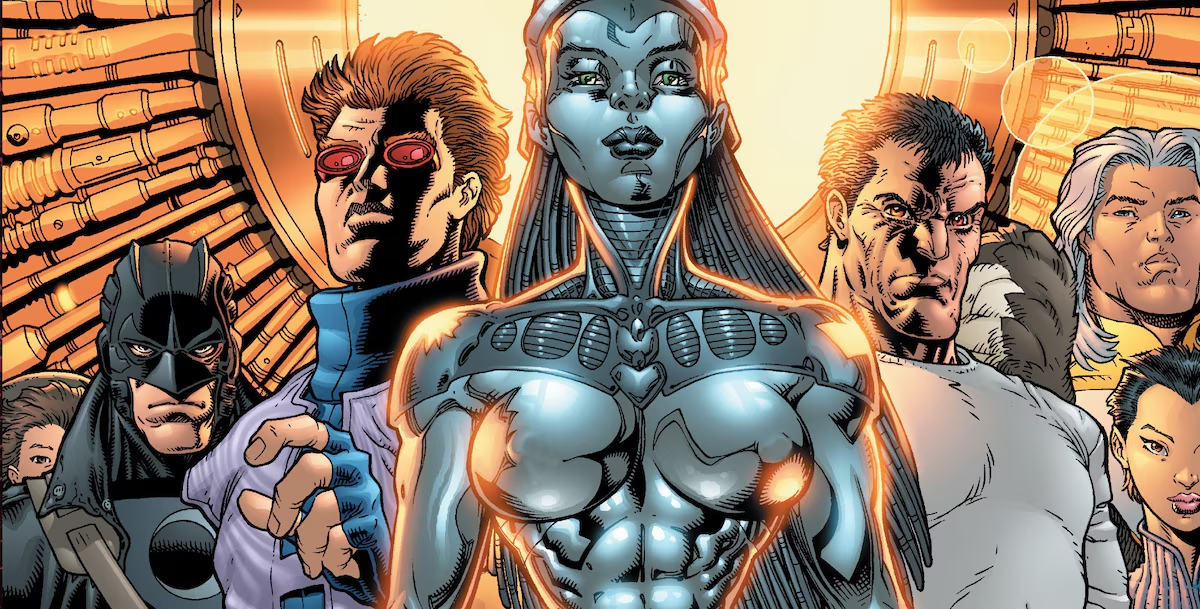
Jenny Sparks, the Spirit of the Twentieth Century: a chain-smoking British woman born on 1 January 1900 who could generate and become electricity. Founder and first leader.
Jack Hawksmoor, the God of Cities: psychically bonded to urban environments, drawing power from them and talking to them.
Swift (Shen Li-Min), the Winged Huntress: wings, talons, superhuman senses — and notably the only pre-Ellis StormWatch character to make it into the new team.
Apollo, the Sun God, and Midnighter, Night's Bringer of War: bio-engineered Superman and Batman analogues, Midnighter able to run combat simulations of a fight before it happens. They were also, openly, a couple — which in 1999 was not a small thing.
The Engineer (Angela Spica), the Maker: a scientist who drained her blood and replaced it with nine pints of nanotechnology, letting her build almost anything out of herself.
The Doctor (Jeroen Thornedike), the Shaman: a Dutch heroin addict who inherited the combined power of every shaman before him.
Their base is the Carrier — a sentient, gigantic inter-dimensional "shiftship" that exists everywhere on Earth at once and travels through the Bleed, the red space between universes.
The pitch was simple and incendiary: these people would fix the world by any means necessary, and they would not be waiting for a Bat-signal or a UN mandate.
The Ellis/Hitch run
Twelve issues, three four-part arcs, and not a wasted page.
The Circle (#1–4) opens with Ellis blowing up Moscow. The warlord Kaizen Gamorra — a holdover from Ellis's StormWatch — unleashes a superhuman army on the world's cities, and the Authority respond by taking the fight to his country directly.
Shiftships (#5–8) brings an imperialist invasion from a parallel Earth, arriving through the Bleed in ships very much like the Carrier.
Outer Dark (#9–12) escalates to the only place left: God. Not a god — the God, the vast entity that manufactured Earth as its future homeworld and has come back to clear the tenants out. The arc ends with Jenny Sparks dying in the final minutes of 31 December 1999, her century expiring with her.
What made it land was Hitch (inked by Paul Neary, coloured by Laura Martin): huge panels, splash pages, a manga-influenced sense of scale that made saving the world finally look like saving the world. The trade-off was decompression — stories stretched across more pages — and the industry followed. The term for it, "widescreen comics," entered the vocabulary because of this book. Hitch and Mark Millar would later export the approach wholesale to Marvel's The Ultimates, which in turn fed directly into the look and tone of the Marvel Cinematic Universe.
Millar, Quitely, and DC losing its nerve
Millar and Frank Quitely took over from #13, with Jack Hawksmoor now leading.
The Nativity (#13–16) is the standout: a shadowy scientist and his army of engineered superhumans — a thinly-veiled riff on the Avengers, run by a sinister Kirby analogue — fight the Authority for control of a baby in Singapore who is the reincarnation of Jenny Sparks. That baby becomes Jenny Quantum, Spirit of the 21st Century.
Earth Inferno (#17–20) sees a previous Doctor turn the planet itself into a weapon. Quitely only drew the back half; Chris Weston handled the first two chapters.
Brave New World introduces the G7 Authority — a state-sponsored replacement team installed after the real Authority are removed for being politically inconvenient. Along the way, Apollo and Midnighter marry and adopt Jenny Quantum, and the Doctor works through his heroin addiction.
And then the censorship. Published in the shadow of 9/11, the run was cut into by DC repeatedly: red filters were dropped over the most violent panels; an Apollo/Midnighter kiss was ordered removed entirely; a Captain America analogue was redesigned and the cover of #14 redrawn and recoloured. Arthur Adams' work on the final issues was substantially reworked — a scene implying necrophilia involving Jenny Sparks' corpse was redrawn and the dialogue rewritten, a gory kill by G7 member Teuton was broken into tamer panels, a sequence of Teuton groping Apollo was softened, a humiliation scene involving Swift was toned down, and a US President who looked too much like George W. Bush was redrawn. A planned mature-readers relaunch by Brian Azzarello and Glenn Fabry was scrapped outright in the wake of the attacks.
The darker irony: The Authority #17, cover-dated September 2000 — a full year before 9/11 — features a tidal wave hitting New York and the Twin Towers coming down. Volume 1 ended with #29 in July 2002. Note for the record that "Transfer of Power," commonly miscredited to Millar, is a Tom Peyer / Dustin Nguyen fill-in arc; the trade of that name collects #22–29.
Crossovers and afterlives
Coup d'État (2004) is the big one — a WildStorm-wide crossover through The Authority, Stormwatch: Team Achilles, Sleeper and Wildcats v3.0, in which the team simply take over the United States.
The Authority: Revolution (2004–05), by Ed Brubaker and Dustin Nguyen, is the hangover: twelve issues about how badly it goes when you actually have to govern the country you conquered.
Planetary/The Authority: Rule the World pits Ellis's own archaeologists-of-the-impossible against his own super-team. Jenny Sparks: The Secret History of the Authority fills in her twentieth century. Garth Ennis contributed the gleefully profane Kev Hawkins miniseries, and there were two Authority/Lobo specials.
Volume 3 was a slow-motion catastrophe. Grant Morrison and Gene Ha launched in 2006, managed two issues, and stalled; Morrison's own retrospective verdict was blunt — "Authority was just a disaster." Keith Giffen was brought in to finish the scripts, and the result limped out as The Authority: The Lost Year. In the meantime, Christos Gage and Darick Robertson delivered Authority: Prime, and Dan Abnett and Andy Lanning ran the post-apocalyptic World's End era through volume 4, which ended in 2010.
Then WildStorm ended. After Flashpoint, the characters were folded into the main DC Universe via a new Stormwatch, teaming Apollo and Midnighter with the likes of Martian Manhunter. Ellis rebooted the entire continuity from scratch in 2017's The Wild Storm. And the book's shadow fell across DC proper: Superman's antagonists the Elite were an explicit riff on the Authority — Grant Morrison and Mikel Janín's Superman and the Authority (2021) closed the loop by having Superman recruit Manchester Black to build a new Authority and liberate Warworld from Mongul.
The series was nominated for Outstanding Comic Book at the 14th and 15th GLAAD Media Awards — a reminder that Apollo and Midnighter weren't a marketing stunt but genuinely load-bearing characters.
On screen
James Gunn announced an Authority film as part of DC Studios' first slate in January 2023 — reportedly without telling Bryan Hitch, who found out the same time everyone else did. As of April 2026 the film is on the back burner; Gunn has said the script wasn't quite there and the story didn't work within the larger DCU. The Engineer, though, has arrived: María Gabriela de Faría played Angela Spica in Superman (2025), working for Lex Luthor, and returns in Man of Tomorrow (2027).
For collectors
The key first appearances sit in Stormwatch, not The Authority: Stormwatch vol. 1 #37 (Jenny Sparks), Stormwatch vol. 2 #4 (Apollo and Midnighter — comfortably the most in-demand of the three), and Stormwatch vol. 1 #48 (the Doctor and the Engineer). All three spiked hard after the 2023 film announcement.
For reading copies: The Authority Omnibus collects vol. 1 #1–29 plus Rule the World, the Jenny Sparks miniseries and the Annual, with a 2025 edition now available. The Absolute editions remain the format of choice for Hitch's artwork — the man drew for that page size whether or not he knew it.