Story from the Vault
Ten Out Of Ten Thousand: The Strip That Promised To End The World And Ran Out Of Time (1968)
28 July 2026 · 2000 AD
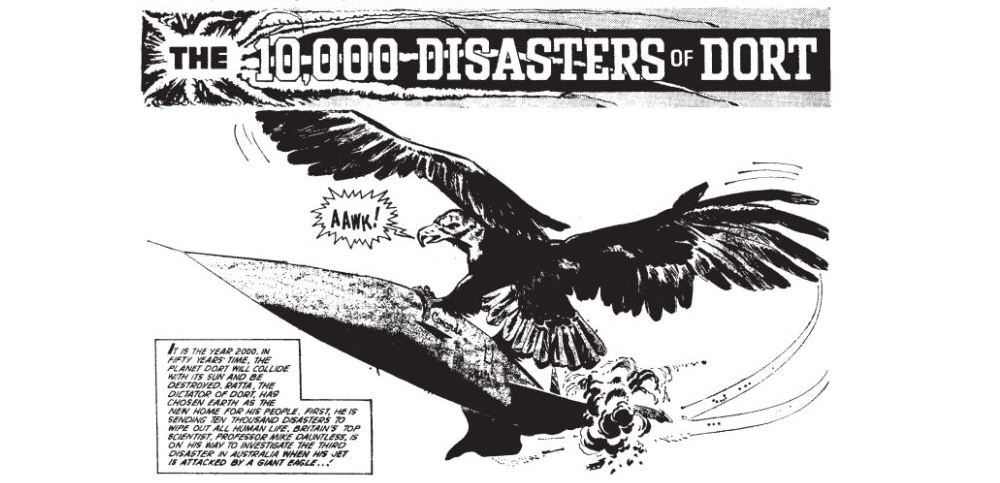
On the eighteenth of March, in the far distant future year of 2000, the last of the great Atlantic liners came steaming into New York harbour and found that there was no New York left to steam into, and half an hour later the ship itself simply folded up and sank, because whatever had unmade the city had also got into her steel and turned it soft. That is the opening of The 10,000 Disasters of Dort, which arrived in the pages of Lion on the eighteenth of May 1968, cost you seven old pence, and gave a generation of British schoolboys a fortnight's worth of nightmares before the third page had finished loading. It is, by any reasonable measure, a magnificent way to start a story, and it tells you immediately that whoever was writing this had understood something that a lot of cleverer people have since forgotten, which is that if you are going to destroy the world you should destroy something the reader can picture, and you should do it before anybody has had a chance to ask questions.
The questions come soon enough, admittedly. The premise, once the smoke clears, is that the planet Dort is on a collision course with its own sun, fifty years out, and its dictator Ratta has looked around the galaxy and settled on Earth as a suitable replacement, with the small caveat that it currently has people on it. His solution is not a plague, or a bomb, or anything so efficient, because this is a British boys' comic in 1968 and efficiency is not the point. His solution is ten thousand individually designed catastrophes, delivered at a rate of roughly one a fortnight, each one announced in advance like a fixture list, which is either the most gloriously theatrical piece of villainy in British comics or the single worst project plan ever committed to paper, and honestly it might be both.
Standing between Ratta and the vacant possession of Earth is Professor Mike Dauntless, described without a flicker of embarrassment as Britain's finest scientist, working out of a laboratory in Cambridge, inventor of among other things the one person helicopter, and blessed with a surname that saves everybody a great deal of characterisation work. He picks up an orphaned French boy called Gaston somewhere in the ruins of Paris, and the two of them spend the next six months of publishing chasing catastrophes around the globe with the harried air of a man who has never once been allowed to finish a cup of tea. Which, given what eventually happens to the tea, turns out to be a mercy.
The company it keeps
To understand why this strip exists at all, you have to understand that Lion was not born, it was commissioned, and it was commissioned specifically to take money off Eagle. Amalgamated Press launched it in February 1952 on cheaper paper with fewer colour pages, undercutting the Hulton title by a penny while matching its page count, and the first issue shifted nine hundred thousand copies before settling to a steady three quarters of a million, which was never quite Eagle's million but was more than enough to keep the lights on. And because Eagle had Dan Dare, Lion was told by management that it needed a space hero of its own, whether or not its editor had the slightest personal interest in science fiction, which by all accounts he did not, and so Captain Condor was duly commissioned into existence as a competitive response rather than a creative one.
That is the family Dort is born into, and it matters, because the whole British science fiction comics tradition of that era is essentially a series of commercial answers to somebody else's question. Dan Dare gave us the clean-jawed pilot of the future and the Mekon glowering from his floating saucer, Flash Gordon had already given the whole medium permission to treat the cosmos as a serial adventure with a cliffhanger every fortnight, and by the time you get to 1968 the vocabulary is fully formed and freely available. Ratta is a Mekon who has read a business book. The giant plants tearing Paris apart had already been done in a Dan Dare story and a Captain Condor serial before Butterworth got to them, and the whole thing sits so obviously in the shadow of Wyndham's triffids that you half expect somebody to mention it in a caption. None of this is a criticism, or at least not one I am inclined to press very hard, because this was a medium built on the joyful recirculation of good ideas at speed, and the interesting question was never whether you had invented the giant weed, it was what you did with it once it had got hold of the Eiffel Tower.
The man at the typewriter and the men at the drawing boards
Mike Butterworth was not, in 1968, a man writing his masterpiece. He had trained as an artist at Camberwell, been turned down when he sent Amalgamated Press his drawings, tried again with a script instead, and been hired as a writer more or less by accident, which is the sort of career origin that ought to be taught in schools. By the time Dort came along he had already written Westerns, historical adventures, Battler Britton, Max Bravo the Happy Hussar, and The Rise and Fall of the Trigan Empire, which remains the thing his name is attached to, and he would go on to write crime novels under his own name and Gothic romances under the name Carola Salisbury, because a freelance writer with a family does not get to be precious about genre. Dort was a bread and butter assignment, two pages a week, no byline, next.
The art is a different story, and it is the reason anybody remembers the strip at all. Luis Bermejo and José Ortiz were part of the extraordinary generation of Spanish draughtsmen who ended up working for British publishers because their own domestic comics market had collapsed at the end of the 1950s, leaving some of the finest storytelling artists in Europe available through agencies at rates that made a London accountant's eyes water with happiness. Wikipedia's history of Lion puts it with a bluntness that I find almost admirable, noting that several strips of the era benefited from IPC's policy of moving towards cheaper artists based in Spain. Benefited. There is a whole book in that word.
So Bermejo, who took over Heros the Spartan from Frank Bellamy and could turn a banal script into a visual event, and Ortiz, who would later draw Rogue Trooper and The Thirteenth Floor and become one of the great horror artists of the Warren magazines, spent 1968 rendering giant eagles smashing aircraft out of the sky over Australia, Rome buried under ice, a black flood of ants pouring across Bavaria, and a reptilian dictator with enormous pointed ears watching humanity suffer with the expression of a man enjoying a boxset. None of them were credited on the page, because British comics of that era did not credit anybody, and that habit of institutional anonymity is why we still do not know who drew the last two episodes of the reprint. Not lost. Never recorded in the first place.
The bit where we talk about the fifth disaster
Right, so. The Rebellion collection carries a notice on the copyright page telling you that the book contains discriminatory content produced in less enlightened times, and I want to be clear that I think putting that notice there is the correct call, not because the strip is uniquely wicked but because it is so ordinarily of its moment that you could miss it entirely if you were enjoying yourself, which you will be.
Here is the tell. Every single one of Ratta's disasters requires him to invent something. He rewrites the atomic structure of steel, he engineers weeds that eat Paris, he enlarges the entire animal population of Melbourne, he doctors the nation's tea so that two retired colonels in Cheltenham put down their cups and set about each other, which is the funniest single idea in the whole strip and the one most likely to be true. He switches off electricity across the planet, he builds an orbital mirror to cook us with our own sun, he puts something in the wheatgerm that reduces ninety per cent of humanity to beasts. Elaborate, expensive, imaginative. Then he gets to the fifth disaster, and for that one he does not invent anything at all, he simply hands advanced weapons to some desert bandits and lets nature take its course, because the story assumes the violence is already there, sitting in the sand, fully assembled, waiting for somebody to plug it in.
That is not a slip. That is load bearing, and it is the exact same assumption that was propping up an awful lot of British public life in 1968, dressed up here in a green rubber suit. The rest of the world supplies the mob, Britain supplies the professor, and the professor is flown out to defend Cairo because obviously the people who live in Cairo were not going to manage it themselves. You can laugh at it, and I did, and you should, but it is worth noticing that this is the one disaster the writer did not have to think up, which tells you it was already in the room.
Two endings, one anonymous hand
The strip promised ten thousand disasters and delivered roughly ten, which even by the standards of British comics is a fairly bold gap between the brochure and the property, and it ran out of road in November 1968 when Dort's scientists sheepishly announced that they had got their sums wrong and the planet was not going to hit the sun after all, at which point Ratta, incandescent at having wasted six months of everybody's time on a clerical error, lunged at Dauntless, missed, and went over a cliff.
Then, five years later, Lion reran the whole thing for a new generation of readers, on the entirely sound editorial theory that the audience turned over completely every four or five years and would never know, and somebody decided the original ending was not good enough. So two fresh episodes were commissioned in which the invasion is instead destroyed by Earth germs, straight out of The War of the Worlds, and those episodes ran in the final two issues of Lion before the comic was folded into Valiant in May 1974, which means that the last thing this strip ever did was carry a dying title over the line. We do not know who wrote or drew them. Nobody wrote it down.
Both endings are in the Rebellion collection, along with the Lion Annual strip in which Dauntless and Gaston fight giant radio-controlled locusts that knock over the GPO Tower, a splendid piece of 1971 annual filler asking whether you believe in flying saucers, a cover gallery, and creator biographies that finally, fifty-five years late, put the names on the work.
Is it a lost masterpiece? No, and anybody telling you otherwise is selling something. The plotting is frantic, the science is decorative, and the ending was clearly written by a man being told to wrap it up by Friday. But it is a genuinely thrilling artefact, drawn by two masters at the height of their powers on a job nobody expected anyone to remember, and it moves with a relentlessness that would not turn up again in British comics until 2000 AD made it the house style nine years later. Fourteen quid, black and white, one disaster after another. Go and meet Ratta. He has been waiting a long time for an audience.
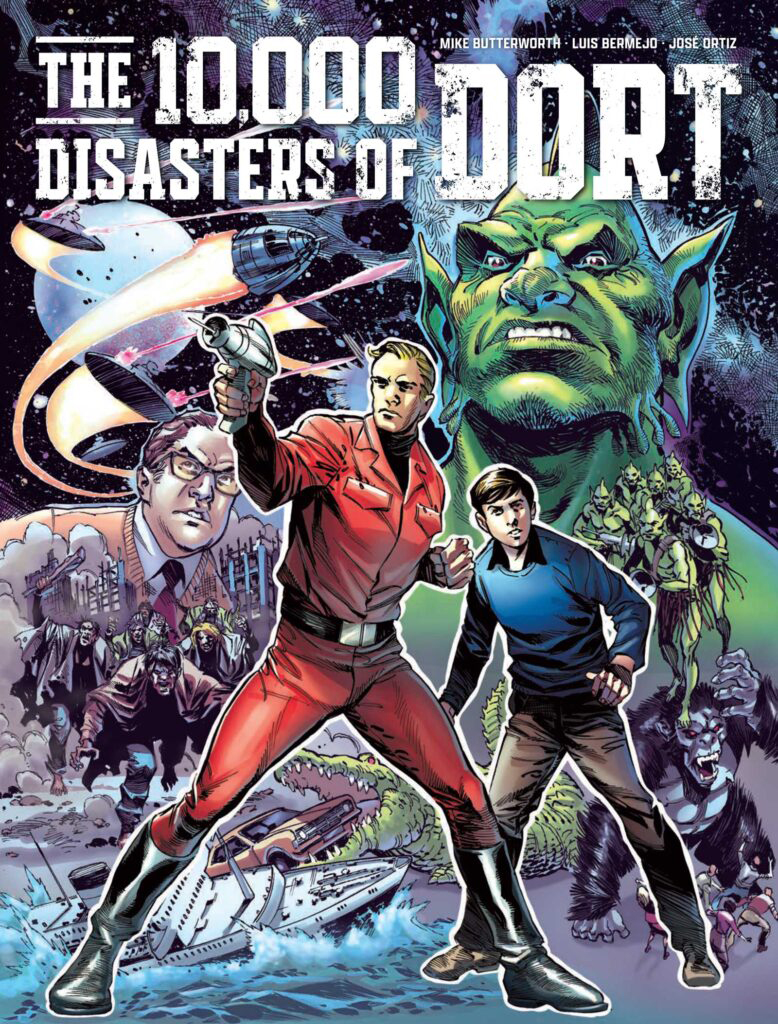
Rebellions Treasury Of British Comics single-volume edition, features a cover by Staz Johnson.