Sixty-five years after she first vanished, Sue Storm is still the most powerful member of Marvel's first family, and Marvel still seems happiest letting her prove it once she has become somebody else.
Sue Storm, Now You See Her (1985)
11 September 2026 · Marvel
Towards the end of The Fantastic Four: First Steps, after Galactus has swatted the Fantasticar into a building and walked off with her infant son, Vanessa Kirby's Sue Storm drags herself out of the wreckage and starts pushing. She has nothing in her hands, only a force field with her whole weight behind it, and she shoves a planet-eating god backwards down a Manhattan street towards the portal that will fling him across the universe, which is the stretch of the film plenty of people came out of the cinema talking about, with TechRadar calling her the most valuable player of the third act. Then the effort kills her, and her baby brings her back. Anyone who has spent time with the comics will have recognised the shape of that scene straight away, because it is the arrangement Marvel has offered Sue Storm for most of her sixty-five years, in which she is allowed to be the strongest person in the room on the condition that the story makes her pay for it.
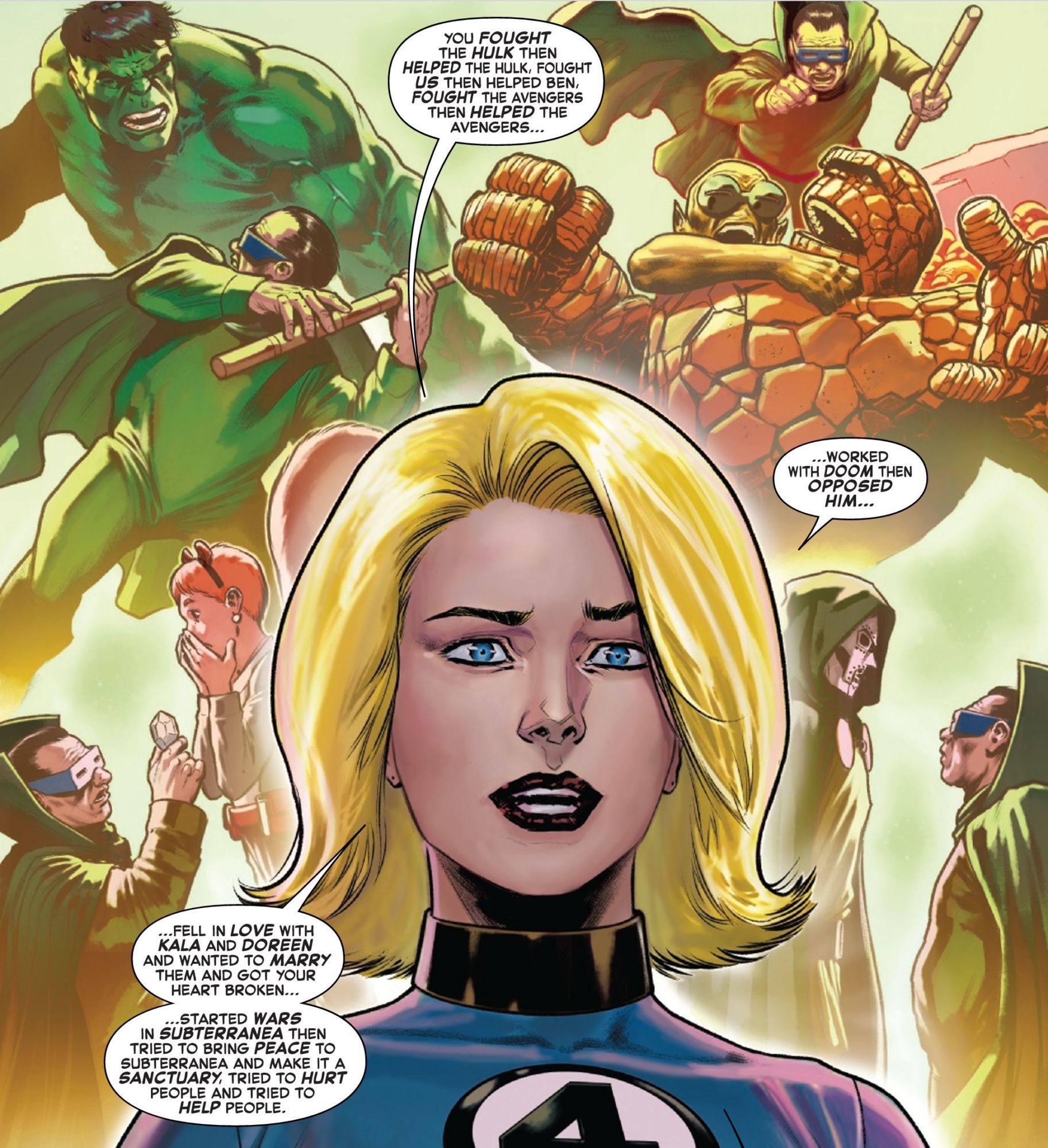
I've long thought Sue is the most underrated hero Marvel has, and the reason has been sitting in plain sight the whole time. For decades she has been introduced as Reed's wife and Johnny's big sister, sometimes as the woman Namor and Doom can't stop wanting, and only rarely as what the page keeps quietly showing her to be, which is the member of the Fantastic Four you would least want to fight.
The girl who disappeared
Sue arrived in Fantastic Four #1 in November 1961, the only woman in Stan Lee and Jack Kirby's quartet, and her power was the ability to vanish. It is hard to write about that without sounding like you're reaching for a metaphor, but Lee and Kirby left it lying on the table for anyone to pick up. In the early issues she is usually the one who gets grabbed and has to be rescued, and her power is written as something that costs her, a strain demanding so much concentration that she can overreach herself doing something as modest as making a large object disappear. From Fantastic Four #4 onwards, when the Sub-Mariner came back and fixed his attention on her, a fair share of her storylines revolved around which man she would end up with. She married Reed in Fantastic Four Annual #3 and had Franklin in Annual #6, and the domestic milestones arrived a good deal faster than any real sense of who she was.
The upgrade that matters came surprisingly early. Fantastic Four #22, cover-dated January 1964, gave her the ability to turn other people and objects invisible and to project force fields, and that issue is where the case for Sue as the team's heaviest hitter really begins. For years afterwards the fields were mostly drawn as static barriers, a handy way to hold a door shut while the men did the punching, although every so often a panel let slip what they could do. In Fantastic Four #167 she brought down the Hulk by sealing off his air with a force field long enough for Ben to finish him, which is a genuinely frightening thing to be able to do to anyone, and Marvel largely left the implication where it lay.
Byrne pulls the thread
It was John Byrne who finally followed it. Across his run as writer and artist in the first half of the 1980s, Sue's fields stopped being walls and became instruments, used to lift and pin and shape matter and to strike at range, and she became visibly more sure of herself using them. Byrne also gave her grief to carry. In Fantastic Four #267 in 1984 she lost her second pregnancy, a complication blamed on radiation she had been exposed to in the Negative Zone, and Byrne gave the aftermath real room in the issues that followed.
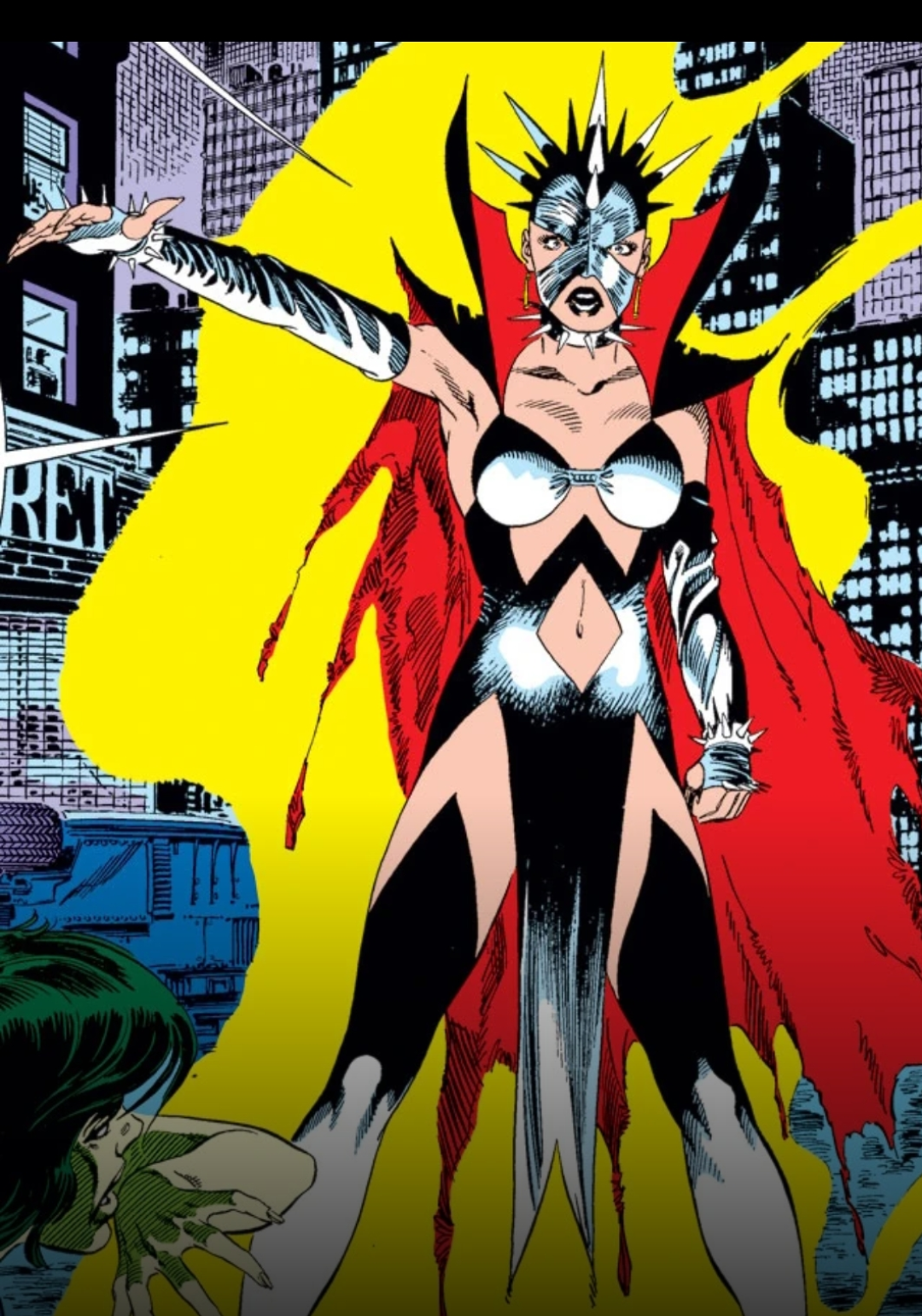
Then came Fantastic Four #280 in 1985. The Psycho-Man, working through his android Hate-Monger, floods Manhattan with pamphlets carrying alien molecules that whip up xenophobic hatred, and the Hate-Monger turns his powers on Sue, who becomes Malice, masked and gleefully cruel, turning everything she has on her own team and going toe to toe with She-Hulk. Reed breaks the spell by deliberately goading her, a cure that sits very uncomfortably forty years on, and when the team follows the Psycho-Man into the Microverse, Sue turns his own control device on him and comes close to killing him. By Fantastic Four #284 she has retired the name Invisible Girl, telling Reed that the girl died when the Psycho-Man twisted her, and she carries on as the Invisible Woman.
Here's where I part company with the usual reading of that arc, which treats it as the moment Sue grew up. The growth is real and Byrne deserves the credit for it, but look at what it cost to get there. Five years earlier Byrne had co-plotted and drawn the Dark Phoenix Saga with Chris Claremont, the story in which Jean Grey finally touches the full extent of her power and it turns her into something that swallows a star, and Malice runs on the same engine. On both of Marvel's flagship teams, the woman at the centre discovered how strong she really was in a story about being taken over by something vile, and in both cases the strength and the vileness arrived together, as though the one couldn't be drawn without the other.
The nineties cut it out
When Tom DeFalco and Paul Ryan took over, they went back to the wound and picked at it. Their Sue feels unappreciated and conscious of her age, seen by everyone around her as a mother before she is seen as a woman, and in Fantastic Four #371 she debuts a revealing costume with a hole cut out of it, a change tied to the lingering influence of whatever had possessed her. The run did give her something Byrne hadn't. After Reed was apparently killed by Doom in Fantastic Four #381, Sue led the team, and led it well, trading the costume for something sensible in #386. The same stretch also dealt with Malice, and the way it did so is telling. Fantastic Four #384 in January 1994 recast Malice as a separate being that had been lodged inside Sue, which allowed a grown-up Franklin, now calling himself Psi-Lord, to pull her out of his mother's mind and into his own, and by #392 later that year she had been shunted into the Dark Raider, an evil Reed from another reality, with an apparent end in #399.
Byrne at least let the darkness belong to Sue. The nineties decided her anger had been an intruder all along, something her son could lift out and file somewhere else, and the character left behind was tidier and a good deal less interesting for it.
Somebody's wife, somebody's prize
The next two decades are where the "Reed's wife, Johnny's sister" label is hardest to shake off. In 2002, Fantastic Four vol. 3 #54 gave back the daughter Sue had lost in 1984, with Valeria born during a dangerous delivery that only succeeded because Doctor Doom stepped in, and Doom's price was the right to name her, which he did after the woman he had once loved. Even the undoing of Sue's grief came with a man's name attached to it. In Civil War in 2006 she made one of the biggest moral calls of her career on Marvel's biggest stage, recognising the damage the Superhuman Registration Act was doing and leaving Reed to fight with Captain America's resistance, although the story wrapped up with the two of them reconciling and stepping away from the team to mend the marriage. Then in Jonathan Hickman and Esad Ribić's Secret Wars in 2015, when Doom finally gets to play God and rebuild reality to his own specification, one of the things he builds is a world in which Sue is his wife and Reed's children are his. When the most dangerous man in Marvel's universe is handed everything he wants, she is on the list, and that is about as clear a statement of her role as the line has ever made.
It took until 2019 for Sue to get a solo series of her own, fifty-eight years after her debut. Tom Brevoort, announcing it, joked that she might have had one already and "you just didn't see it," which is funny and also a fair summary of the whole problem. Mark Waid and Mattia De Iulis used the five issues to give her a covert past running an espionage mission for S.H.I.E.L.D., sending her into Madripoor alongside Black Widow to rescue her old partner, and the book treats her competence as a given from the first page, which is exactly why it felt so unusual.
Unchained
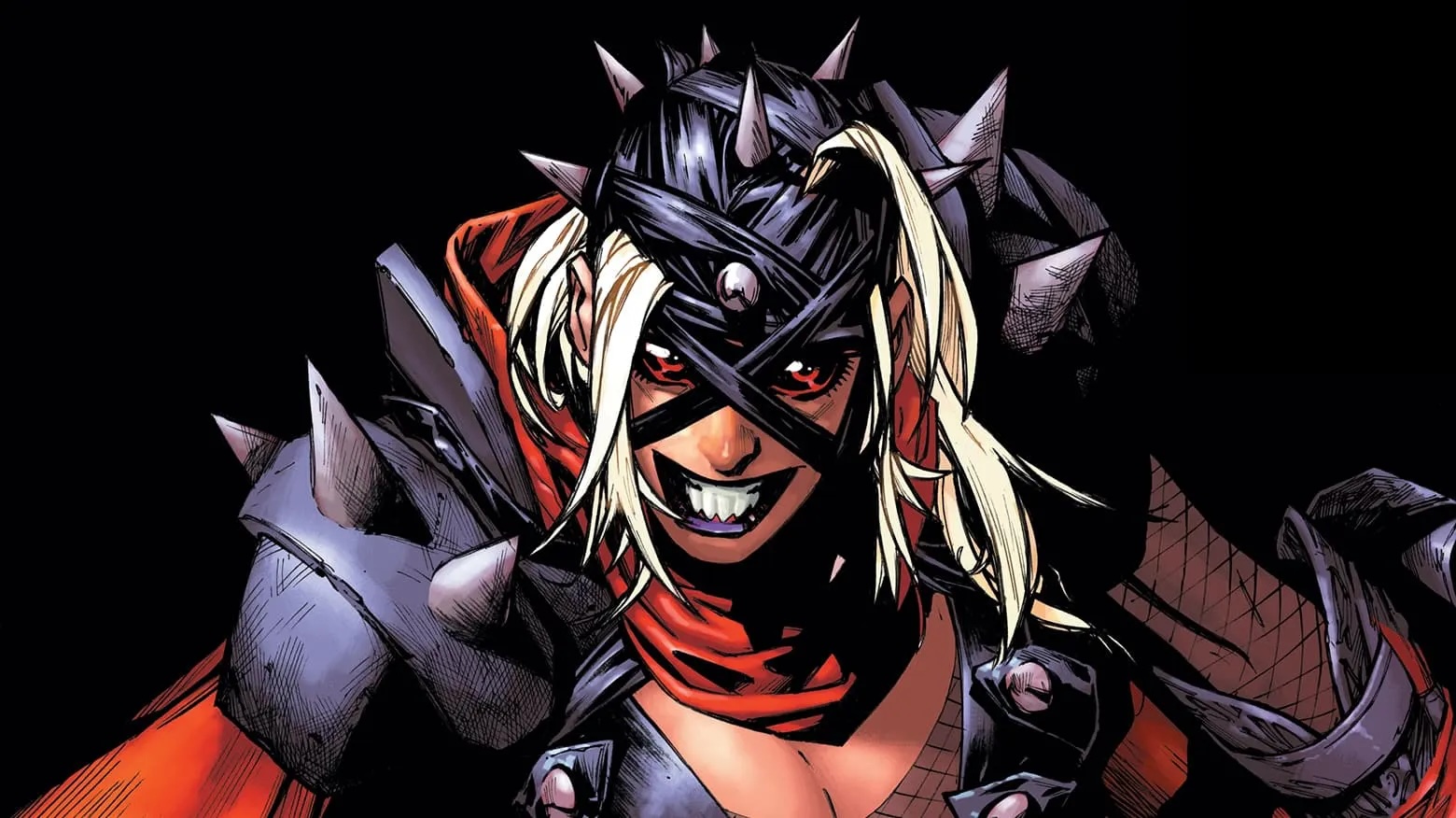
What eventually dragged Malice back into the light was a video game. When Sue's Malice costume arrived in Marvel Rivals in early 2025 it became one of the game's most sought-after skins, and Marvel noticed. Ryan North and Humberto Ramos answered with the Invincible Woman in Fantastic Four #6 to #8, running from December 2025 to February 2026, an alternate Sue driven mad by her power and haunted by a mistake that cost her everything, dressed in a variant of the Malice look and borrowing her name from the Invincible Man disguise of Fantastic Four #32. North's pitch was that the real threat hidden inside the Fantastic Four has always been "an unchained Susan Storm." At least one critic came away from #8 convinced it showed Sue might be the most powerful being in the Marvel Universe, while others hated it, which is the usual fate of any story that pokes at a character this old.
North is right, and his line is the whole problem in miniature. Look back over sixty-five years and the versions of Sue who hold nothing back are Malice, twice over, and a variant who cut out her own conscience to get there, while the Sue who keeps everything reined in is the one the books let be a hero. North points out that Reed has his evil variant too, in the Maker, but the Maker is presented as a brilliant man who went bad, whereas the Invincible Woman is pitched as what Sue would be if she simply stopped holding herself in, which is a different and far more damning idea about who she is.
Paying for it
Which brings me back to that Manhattan street. First Steps, released in July 2025, deserves real credit for how it handles Sue, most obviously by giving her full force-field powers from the start of her career and skipping the two decades the comics took to trust her with them, and Kirby plays her as the one who holds the city together as well as the family, talking the Mole Man into sheltering New York underground while Galactus closes in. Yet when the film needs Galactus beaten, it follows the old contract to the letter, since Sue wins, the winning kills her, and her son, a baby with the Power Cosmic in his hands, is the one who gives her life back.
She returns in Avengers: Doomsday on 18 December 2026, alongside Robert Downey Jr.'s Doctor Doom, a character whose comic-book counterpart has spent six decades trying to take her family and once rebuilt the multiverse to do it, and whose film version was last seen standing in her son's room. What I'd like from that film is fairly simple. I'd like to see Sue Storm use everything she has and still be on her feet when the credits roll, with the story treating that as the heroic ending it would be for anyone else on the poster.
Key issues and sources
Cover dates are given where sources agree. Where sources disagree, or where a detail comes from general knowledge and wasn't independently checked for this piece, that's flagged so it can be verified against the physical issues before publication.
Fantastic Four #1 (November 1961). Debut, Lee and Kirby. Source: Wikipedia, "Invisible Woman", https://en.wikipedia.org/wiki/Invisible_Woman
Fantastic Four #4 (1962). Namor's return and fixation on Sue. General knowledge, not checked for this piece.
Fantastic Four #22 (January 1964). Force fields and projected invisibility. Sources: Wikipedia, as above; SuperMegaMonkey Chronocomic, https://www.supermegamonkey.net/chronocomic/entries/fantastic_four_22.shtml
Fantastic Four Annual #3 and #6. Wedding and Franklin's birth. Source: Marvel Database, FF #388 notes, https://marvel.fandom.com/wiki/Fantastic_Four_Vol_1_388 (years of 1965 and 1968 are general knowledge and have been left out of the body text).
Fantastic Four #167. Sue cuts off the Hulk's oxygen. Source: Marvel Database, FF #280 notes, https://marvel.fandom.com/wiki/Fantastic_Four_Vol_1_280 (the 1976 cover date is general knowledge, so it's omitted from the body text).
John Byrne's run (early to mid 1980s). Expanded use of force fields. Source: Wikipedia, as above. Exact run dates are general knowledge.
Uncanny X-Men Dark Phoenix Saga (1980), Claremont and Byrne. General knowledge, not checked for this piece.
Fantastic Four #267 (1984). Miscarriage linked to Negative Zone radiation. Source: CBR, https://www.cbr.com/fantastic-four-valeria-richards-doctor-doom-name/ (cover month varies across sources, so only the year is used).
Fantastic Four #280 and #281 (1985). Malice, Hate-Monger, Psycho-Man. Sources: Marvel Database, as above; Earth's Mightiest Blog, https://earthsmightiestblog.com/fantastic-four-280-284/ ; HipComic/ComicBase listing, https://www.hipcomic.com/listing/fantastic-four-vol-1-280-fn-marvel-john-byrne-sue-storm-malice/11777598 . Date discrepancy: Marvel Database gives April 1985, the ComicBase listing gives a July 1985 cover date.
Reed breaking the spell. Accounts differ on the method, with one describing it as mental abuse and another as a slap, so the body text says "goading" and should be checked against #281. Sources: Marvel Rivals Wiki, https://marvelrivals.fandom.com/wiki/Malice ; Earth's Mightiest Blog, as above.
Sue nearly killing the Psycho-Man. Source: Marvel Database, Susan Storm (Earth-616), https://marvel.fandom.com/wiki/Susan_Storm_(Earth-616)
Fantastic Four #284 (1985). Becomes the Invisible Woman. Source: Screen Rant, https://screenrant.com/fantastic-four-mcu-origin-invisible-woman-powers-change/ . Screen Rant quotes her line to Reed directly; the body text paraphrases it, so check the exact wording in the issue if you want it verbatim.
Fantastic Four #371 to #386 (December 1992 onwards). Costume change and Sue's leadership. Sources: CBR, https://www.cbr.com/gimmick-or-good-fantastic-four-371-375/ ; CBR costume history, https://www.cbr.com/fantastic-four-costume-history/ ; Comic Watch, https://comic-watch.com/news/paul-ryan-tom-defalco-fantastic-four
Fantastic Four #381. Reed apparently killed by Doom. Source: Marvel.com, https://www.marvel.com/articles/comics/the-longest-lasting-marriage-in-the-marvel-universe
Fantastic Four #384 (January 1994), #392 (September 1994), #399 (1995). Malice retcon, transfer to the Dark Raider, apparent end. Sources: Marvel Database FF #392, https://marvel.fandom.com/wiki/Fantastic_Four_Vol_1_392 ; TheGamer, https://www.thegamer.com/marvel-rivals-malice-lore-story-explained/ ; Bounding Into Comics, https://boundingintocomics.com/movies/movie-news/hot-off-her-marvel-rivals-arrival-fantastic-four-first-steps-star-vanessa-kirby-says-mcu-sue-storm-will-have-tones-of-malice
Fantastic Four vol. 3 #54 (2002). Valeria's birth, named by Doom. Source: CBR, as above.
Civil War (2006) and Secret Wars (2015). Source: Marvel.com, as above; CBR, https://www.cbr.com/doctor-doom-marriage-secret-wars-invisible-woman/
Invisible Woman #1 to #5 (July to November 2019), Waid and De Iulis. Sources: CBR announcement including the Brevoort quote, https://www.cbr.com/fantastic-four-invisible-woman-solo-marvel-series/ ; Barnes & Noble collection listing, https://www.barnesandnoble.com/w/invisible-woman-mark-waid/1134986405
Fantastic Four (2025) #6 to #8 (December 2025 to February 2026), North and Ramos. Sources: Marvel.com, https://www.marvel.com/articles/comics/fantastic-four-6-cover-malice-invincible-woman-marvel-rivals-spray ; AIPT, https://aiptcomics.com/2026/02/18/fantastic-four-8-review-2/ ; Comic Book Roundup, https://comicbookroundup.com/comic-books/reviews/marvel-comics/fantastic-four-(2025)/8 . The Fantastic Four #32 Invincible Man link is from a single review and the Marvel Database FF #388 notes.
The Fantastic Four: First Steps (25 July 2025). Sources: TechRadar, https://www.techradar.com/streaming/entertainment/the-fantastic-four-first-steps-ending-and-post-credit-scenes-explained ; GamesRadar+, https://www.gamesradar.com/entertainment/marvel-movies/fantastic-four-first-steps-ending-galactus-franklin-power-cosmic-doomsday/ ; Screen Rant, as above; EW interview with Matt Shakman via AOL, https://www.aol.com/fantastic-four-first-steps-director-113000657.html
Avengers: Doomsday (18 December 2026). Sources: Fandango, https://www.fandango.com/avengers-doomsday-2026-237176/movie-overview ; Rotten Tomatoes, https://editorial.rottentomatoes.com/article/everything-we-know-about-avengers-doomsday/