Story from the Vault
Shakara (2001)
1 June 2026 · 2000AD
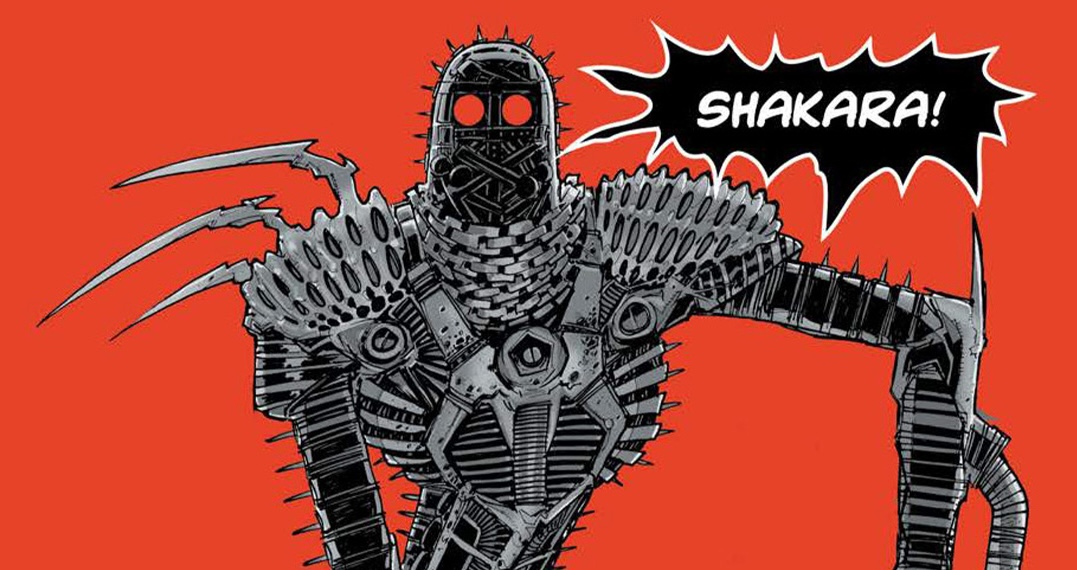
The protagonist is a problem. Not in the sense that he fails as a character, but in the sense that he refuses to be one. Shakara opens after its human subject is already dead. Adam, the man who might have anchored us, is murdered in the first beats of the story along with the rest of his species, and what arrives in his place is a machine of pure retribution: faceless, voiceless, shifting its anatomy to suit the next kill. The book's central decision is to give us nothing to hold onto. There is no interiority here. There is no arc. There is a geometry of vengeance moving through a galaxy that has already lost.
This is the fault line the work stands on, and it stands on it deliberately. A revenge story usually depends on the audience's identification with the wronged party. We want the killer to suffer because we have been made to feel the loss. Shakara withholds the loss almost entirely. Humanity is exterminated in a gesture, off to the side, before we have learned to care. What we are left to identify with instead is the instrument. And an instrument cannot grieve, cannot doubt, cannot be talked out of its function. It can only continue.
The avenger with nothing left to avenge
Robbie Morrison's script makes a wager that is easy to miss under the carnage: that an audience will follow a story about consequence even when the thing being consequenced is, by any human measure, already irrelevant. The race Shakara exists to avenge is gone. Restoring it is not on the table. So the violence accumulates without the usual redemptive payoff, the moment where suffering converts into meaning. Each enemy destroyed returns nobody. The math never balances because it cannot.
That refusal is where the work becomes interesting rather than merely kinetic. Strip a revenge narrative of the possibility of restoration and you are left with a question the genre normally rushes past: what is vengeance for, when it changes nothing? The honest answer the book keeps circling is that it is for nothing. It is a process that runs until the fuel is gone. Shakara is less a hero than a closed system executing its last instruction long after the institution that issued it has ceased to exist.
What the art argues that the script does not
The visual authorship here is split across a striking range of hands, and the seams matter. Henry Flint and Clint Langley do not draw the same book. Flint's work carries a grotesque, hand-built density, a sense that every horror was constructed object by object and means to disgust you on contact. Langley's painted, digitally assembled spreads operate at a different register entirely: cold, vast, processed, more interested in scale than in skin. Chris Blythe's colour and the contributions of Nick Percival, Brendan McCarthy and Steve Cook push the palette toward something that does not read as a single coherent universe so much as a sequence of escalating environments, each more inhuman than the last.
This is usually a weakness, the visible hand-off between artists fracturing the world. In Shakara it functions as argument. A book about a protagonist with no fixed form, who reshapes his own body to match each threat, told by artists who refuse to settle on a fixed visual language, becomes formally consistent with its subject. The instability is the point. There is no stable human eye organising this galaxy because the human eye is precisely what has been removed from it. Ellie De Ville's lettering threads through all of it, the one constant element, the only voice in a story whose central figure has none.
2000AD and the machinery of cruelty
Serialised in 2000AD across the early 2000s and gathered here as a complete collection, Shakara arrives out of a publishing tradition that has spent decades using extremity as a critical instrument rather than an indulgence. The anthology built its reputation on stories where the violence interrogates the systems producing it. Shakara inherits that posture but tests its limits. The systemic cruelty here, the genocide that sets the engine running, is real and total. The question is what the book does with it.
It would be too generous to claim the work fully interrogates its own bloodshed. Much of it aestheticises. The spreads are designed to be magnificent, and they are. But the aestheticisation is not the whole transaction, because the book denies you the satisfaction the imagery seems to promise. You are given spectacle and then refused the catharsis that spectacle usually serves. That gap, between the gorgeousness of the destruction and the hollowness of what it accomplishes, is where the work earns more than its surface.
The question it leaves open
Here is what Shakara sets in front of you and declines to resolve. If a wronged people are gone, completely, and the only thing left of them is a weapon that cannot stop, do we want that weapon to succeed? The book invites us to cheer the destruction of those responsible while quietly removing every reason that destruction should matter. There is no one left to be avenged. There is no future to be secured. There is only the continuation of a function.
You are placed, as a reader, in the position of wanting an outcome you cannot justify. That discomfort is the truest thing in the book. Shakara imagines the end of the human and then asks what it would mean to keep fighting on humanity's behalf in a universe that no longer contains any. The machine continues because continuing is all it has. Whether you find that tragic or simply mechanical may say more about what you believe a human life was worth in the first place than anything the work is willing to state outright.