Story from the Vault
Justice League Dark: The Best DC Film Nobody Made (2022)
9 July 2026 · DC Comics
Guillermo del Toro is on a podcast promoting his Frankenstein, and halfway through he starts describing a plane. The team needs one, he says, someone mentions a friend who happens to have a plane, and a beat later you are standing in Bruce Wayne's office with no fuss made about any of it. He is describing a film he will never make, in the present tense, the way you might describe a house you lived in years ago and could still walk through in the dark.
That present tense is the whole mood of the thing now. A man in his sixties, out doing press for a different film entirely, laying out the shape of the one that got away as though the pages were still warm, and after following this on and off for more than a decade I wanted to set it down properly before the details scatter, because the details are extraordinary and most of them have only surfaced in the last few weeks.
The timing is the first thing worth holding. Talk of a del Toro Justice League Dark began stirring in 2011 and 2012, barely a year after Peter Milligan and Mikel Janín launched the New 52 book, and he confirmed it himself in January 2013 under the working title Dark Universe. That puts it before the DC Cinematic Universe existed at all, dreamt up ahead of Man of Steel and everything Man of Steel would drag into being, back when nobody had yet learned to fear the word shared. He spoke then about finishing his bible, forty-odd pages of it, with the particular tenderness of a man assembling something he had been carrying in his head since he was small, which, by his own telling, he had been. Swamp Thing and Etrigan were characters he drew as a boy, he has said, and you simply do not get that sentence out of a writers' room.
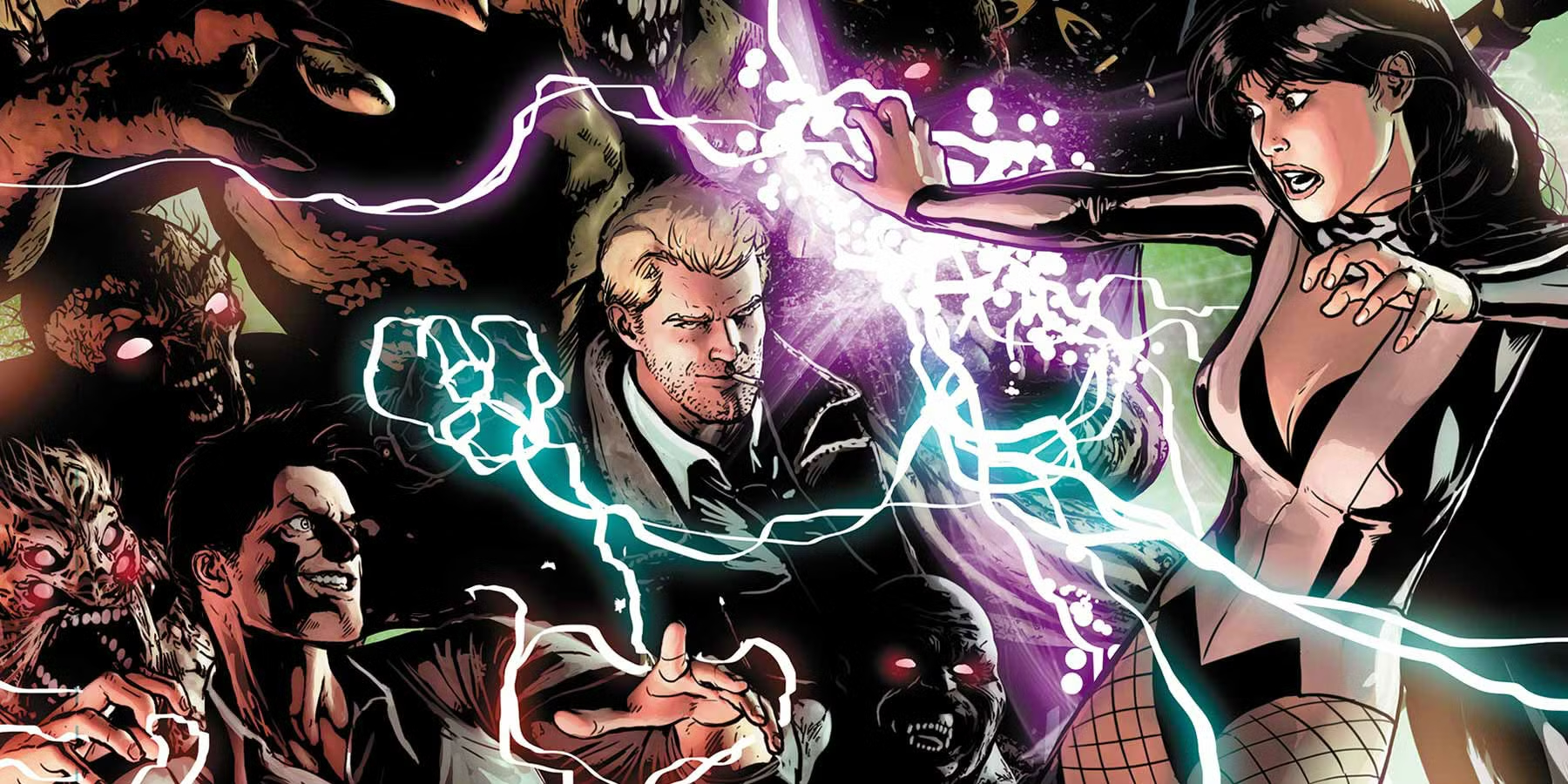
The film he described was not an ensemble in the way we have wearily come to understand the word, six logos arranged on a poster. It was a story with a door in and a door out, and Constantine was both. Around him del Toro set the ones he had loved longest, Deadman, Swamp Thing, Etrigan, Zatanna, Klarion the Witch Boy, with the Floronic Man opposite them and Swamp Thing built up rich and strange in the collision. The reading underneath it was specific enough to reassure anyone who fears these films being made by people who have never turned a page. He lifted the opening from Alan Moore's Constantine, took the wrecked romance of Abby Arcane and Swamp Thing, and reached in particular for those unsettling moments when Deadman slips inside a living body and has to wear another person's consciousness from the inside out, which is about as del Toro as anything in DC gets, the soul housed in the wrong flesh.
He had it half cast in his own head, too. Deadman was to be Doug Jones, his lifelong man-in-the-suit, the body inside the Faun and the Amphibian, because he could carry the physicality and del Toro already knew his every mannerism. And then the plane, that small perfect gag I keep circling back to, Batman folded into the story as a favour rather than an event, the most over-explained man in modern cinema reduced to a bloke you happen to know who owns aviation. Only a director entirely at home in the dark corners would treat the bright centre so lightly, and it tells you the film would have been funny, and unbothered, and completely sure of what it was.
What went wrong was not the work. What went wrong was the machine warming up around it. You can hear del Toro's language change across the interviews of those years, sliding from a man making his film to a man being told his film would need to fit the plan, and by the plan they meant the shared universe closing its fist. He handed in a finished script in late 2014, revised it through 2015, waited for a green light that never quite came, and then did what he so often does, left towards work that would actually get made, Crimson Peak and the second Pacific Rim. By the middle of 2015 his name was off it.
After that it did the slow expensive nothing these projects always do. Scott Rudin came aboard as producer, Doug Liman was announced to direct in the summer of 2016, leaving Fox's Gambit to take it, with Michael Gilio writing and the title still Dark Universe right up until Universal claimed that name for their own monster franchise, the one that collapsed under a Tom Cruise Mummy before it had properly begun. Liman was gone by May 2017. Warners still paraded the project at Comic-Con that July under the finally settled Justice League Dark title, still had someone polishing the pages, still circled directors with Andy Muschietti among them before he drifted off to the Flash film that became its own object lesson. J.J. Abrams and Bad Robot then arrived in 2020 to develop a whole Justice League Dark universe across film and television, that corporate spell which guarantees nothing happens by resolving to think about it forever, and nothing did. By the time Gunn and Safran had the keys, the characters had been quietly split up and sent elsewhere, Swamp Thing to his own picture, Constantine into the endless perhaps of a series. Through all of it the studio kept looking straight past the one finished script it already owned, at something easier to measure.
It is easy to play the whole decade as farce, and plenty have, the revolving door, the stolen title, the running joke of a slate fat with films forever in development and never once in production. The honest version, though, only shows up in the rear-view mirror, that late useless clarity where you look back down the road and finally see the wreckage you left by driving too fast, the turnings taken at speed because everyone in the car was shouting about momentum. Del Toro's Justice League Dark did not die of being bad. By every account it was the opposite, a small, odd, character-led horror film made by the one director whose whole sensibility fit the material like a key turning in a lock. It died of being the wrong material for the weather, because a system tuned for scale and connective tissue and the promise of the next thing had no idea what to do with a film whose entire argument was smallness, and rot, and the beauty of a soul in the wrong body. Nobody failed to make it for want of talent. The talent was in the room, holding the pages, while the machine counted past him.
And then the ending that tips the whole thing from frustrating into sad, because when Josh Horowitz asked him lately whether he would make it now, del Toro said no. Not bitter, just tired. He loved that screenplay, he said, he was in love with it, he would have loved to have made it, and now he wouldn't. He has made his peace, spoken warmly of Gunn's take on the universe, said he is chasing no DC film, admitted he has never once pitched it to the only man who could say yes. The door does not slam so much as get pulled quietly shut, from the inside, by the person who built the house.
One ember survives, and it is a real one rather than a fan's daydream. The script exists. A finished, revised del Toro draft of Justice League Dark is sitting in a Warner vault as you read this, done, months or years of a real life turned into pages nobody opens. Gunn and Safran have let filmmakers work their own corners on their own terms before now, and folded into that fact is a version of events where a document that has waited more than ten years is finally picked up by someone with the nerve to shoot it as written. Likely not him. Likely not soon. But the pages are real, and in a story this crowded with things that were only ever imagined, real counts for a great deal.
There is a thing del Toro said recently, talking about how you ever make anything your own inside these franchises, that has been turning over in me since I heard it, because he answered that question by counting too, only his counting runs the other way. How many notes are there, he asked, how many letters in the alphabet, a small fixed number of each, and out of that tiny finite set has come every book and every piece of music we have ever made, all of it renewable, endlessly, because the printing blocks never change, only what we set with them does, and every voice is its own. It quietly turns the whole story over, because the machine was never the villain for being a machine. The alphabet is a machine. So is a plane. Constantine and Swamp Thing and a Batman with a spare aircraft are printing blocks, finite, ordinary, shared out equally among every studio holding the same short list of names. The waste was never that the blocks existed. The waste was a company sitting on precisely the same set as everyone else, and choosing to arrange them into the same tired sentence everyone else was arranging, with one of the few genuinely singular voices we had standing right there in the room, script finished, asking only for the chance to press those ordinary blocks into something no one had read before.
That is the loss, in the end, and it is a quieter one than the fan campaigns make it, no film torn away from us by people who hated it, only a rare voice left holding a finished page while the machine, holding the very same letters, spelled out something safe.