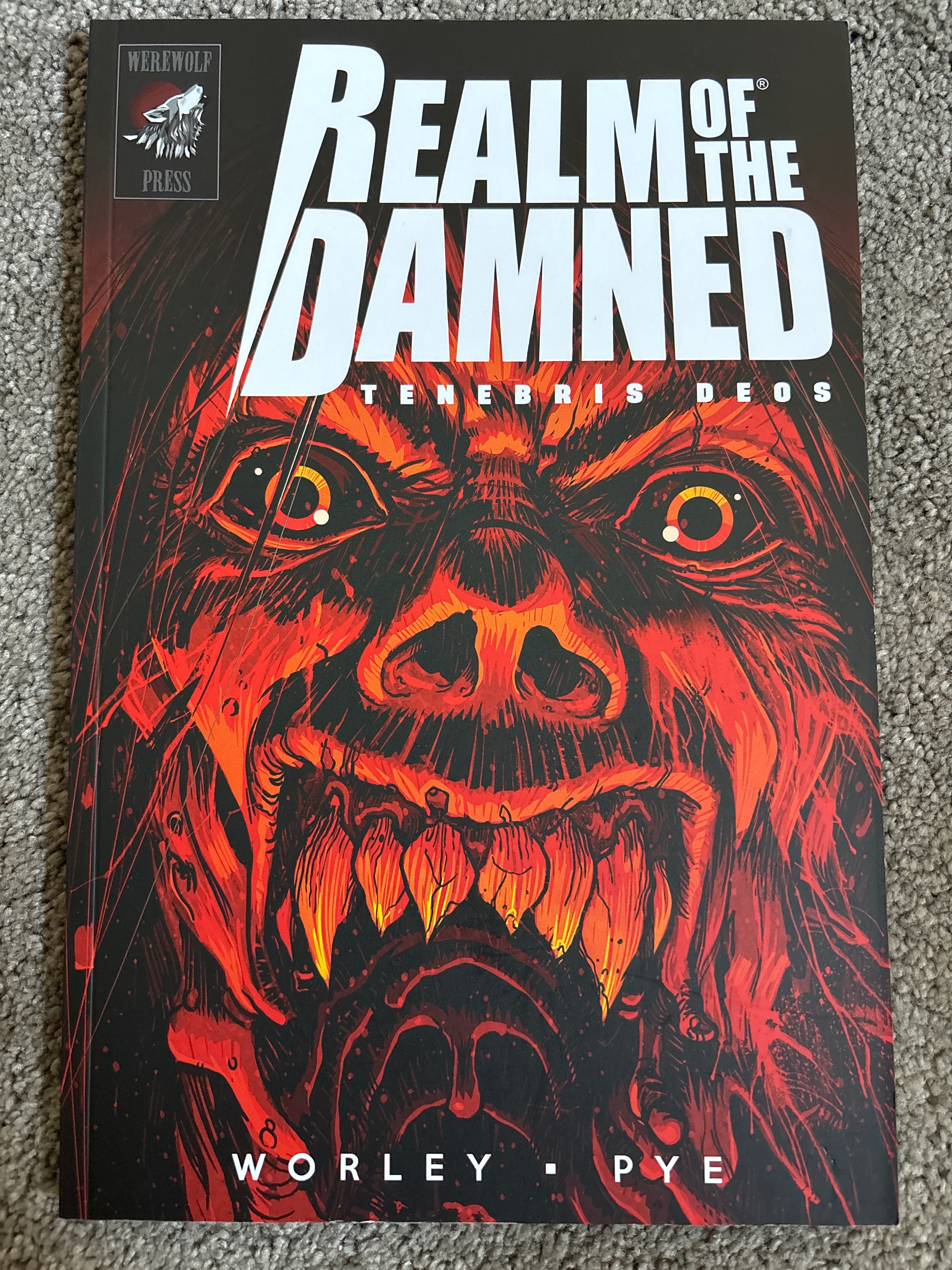
The most bombastic vampire romp since Blade?
Realm of the Damned - Tenebris Deos (2016)
5 January 2026 · Werewolf Press
Some comics announce themselves politely from the shelf. Realm of the Damned: Tenebris Deos does not. It seems to glare out from the stack, all bruised blacks, ceremonial reds, and the sulphurous promise of something played very loudly after midnight. Hold the 2016 Werewolf Press volume in your hands and it feels less like a conventional graphic novel than an artefact smuggled out of a gig venue, part horror comic, part metal sleeve, part church window shattered and reassembled by someone with a taste for vampire mythology.
That physical attitude matters. The book arrived at a moment when comics culture was widening its appetite for handsome, specialist editions, and when readers were increasingly willing to follow genre work outside the usual superhero and trade paperback lanes. Horror comics had already clawed back a great deal of respect in the 2000s and 2010s, but Realm of the Damned came at the form from a slightly different angle. It wore its black metal influence on its sleeve, not as decoration, but as a guiding temperature. Its world is blasted, grandiose, filthy, romantic, and rotten, in exactly the way the best extreme horror fantasies can be.
A black metal graphic novel from the margins
Published by Werewolf Press in 2016, Realm of the Damned: Tenebris Deos was presented as a full blooded horror graphic novel with a strong musical identity. Werewolf Press was not one of the giant names of the comics rack, and that is part of the book’s appeal now. It belongs to the tradition of small press and specialist publishing that knows exactly who it is speaking to. Rather than chasing the centre of the market, it plants its boots firmly in the fog, raises the volume, and invites the faithful to come closer.
The subtitle, Tenebris Deos, gives the thing a ritual flavour before the first page has properly begun. This is not a polite Dracula pastiche, though it draws deeply from the long history of vampire fiction. It is a modern Gothic nightmare filtered through album art, occult melodrama, and the British comics knack for giving pulp material a nasty satirical edge. In comics history, it sits in an interesting side chamber, near the door marked music crossover and not far from the shelves where 2000 AD veterans, horror anthology readers, and metal fans tend to meet.
That crossover is important. Comics and heavy music have been flirting with one another for decades, from painted covers and band mascots to licensed projects and underground zines. Realm of the Damned is more committed than most to making the relationship feel organic. It is not simply a comic with a metal poster attached, nor a piece of merchandise pretending to be a story. Its art direction, rhythms, and imagery all understand that metal, at its most theatrical, is world building by other means.
Worley, Preece, and Parr turn the volume up
Alec Worley was a natural fit for this kind of assignment. By the time Tenebris Deos appeared, he was already known to many British comics readers through work connected with 2000 AD and the Judge Dredd Megazine, along with fiction and licensed comics that showed a fondness for genre machinery. Worley writes horror with a clear sense of pace, but he also understands the joke that often sits in the crypt. His scripting here has that useful British ability to respect Gothic excess while also knowing how ridiculous, and how wonderful, it can become when everyone commits to it fully.
Luke Preece brings another strand of visual culture into the mix. Known widely as an illustrator with a strong feel for screen print grit, gig poster energy, pop culture iconography, and heavy music imagery, Preece’s involvement helps place the book in a space where comics art and poster art speak fluently to one another. His sensibility suits a project that wants to feel collectible before the reader has even reached the endpapers. This is the kind of book where the design of a figure, the fall of a logo, and the weight of a shadow all carry part of the storytelling burden.
Pye Parr’s contribution is equally central to how the volume lands. Parr, another creator with ties to the British comics scene, has long had a sharp eye for design, colour, and the production values that make a page sing rather than merely function. In Realm of the Damned, that eye helps fuse the lurid and the legible. The pages can be dense with mood, yet they keep their forward pull. The result is a book that understands spectacle, but does not leave the reader stranded in the smoke machine.
What these creators share is a feel for genre as performance. They are not apologising for vampires, hellish architecture, snarling monsters, or sacred symbols turned inside out. They are leaning into them. The joy of Tenebris Deos is that it treats its excess as a language with rules, not as a pile of cool images. The work knows the difference between noise and atmosphere, even when it is pretending not to.
Alberic Van Helsing and the end of holy certainty
At the centre of the book is Alberic Van Helsing, a name built to carry expectation. Any Van Helsing arrives trailing a long coat of literary history, from Bram Stoker onward through films, comics, television, and games. Alberic is not merely a museum label with a stake in his hand. He is a hunter shaped by exhaustion, by violence, and by the sense that the old war against darkness has gone badly wrong. The world around him feels spiritually diseased, a place where monsters have not crept into civilisation so much as inherited it.
The story follows him through a landscape ruled by the damned, where vampire power and infernal politics have swollen into something close to empire. The plot trades in familiar pleasures, ancient evil, ruined faith, secret histories, grotesque courts, and brutal confrontations, but its real charge comes from tone. Alberic is a hard bitten figure, yet the book does not reduce him to a simple action hero. He works because he carries the weight of a tradition that may no longer be enough. A Van Helsing is supposed to know how to name evil and destroy it. Here, naming evil is the easy part.
That gives the supporting world a particular bite. The creatures of Tenebris Deos are not just obstacles waiting to be cleared. They feel like inhabitants of a cosmology that has already won several important battles before the reader arrives. The vampires are decadent, cruel, and theatrical, but the theatricality is not empty. It tells us that power loves costume, and that immortality, given enough time, may become a kind of aesthetic sickness.
Worley keeps the machinery moving without overexplaining the lore to death. That restraint is welcome, because a world like this benefits from shadows left unopened. The best horror comics do not answer every question about the basement. They let you hear something breathing down there and trust you to imagine the shape. Realm of the Damned is strongest when it lets implication, design, and atmosphere do their work beside the dialogue.
Reception to the book was shaped by its specificity. It was never going to be a neutral object. Readers drawn to Gothic horror, extreme metal imagery, and British genre comics found something made with unusual commitment to that overlap. Others may have found its theatrical darkness too rich, too loud, or too steeped in a particular subculture. That, frankly, is part of why collectors still talk about it. Interesting comics often carry the marks of a strong preference. They risk being too much for some readers because they are trying to be exactly enough for others.
As a collectible, Realm of the Damned: Tenebris Deos has the appeal of a book that sits slightly outside the standard lanes. It is tied to a small publisher, to a clearly defined aesthetic moment, and to creators whose work connects comics, illustration, design, and music culture. For collectors, those intersections matter. A copy is not only a reading object, but a marker of a period when horror comics were continuing to prove how elastic the form could be, especially when allowed to borrow heat from neighbouring arts.
Its wider legacy is not measured in franchise dominance or endless spin offs. It is better understood as a cult object, the sort of book that finds its people one recommendation at a time. Someone mentions Van Helsing. Someone else mentions black metal. A third person remembers the art, the mood, the sheer nerve of the thing. Soon enough, a reader is hunting for a copy because it sounds like it should not quite exist, and because comics are often at their most rewarding when they wander beyond the well lit road.
If you have a taste for vampire horror with mud on its boots and candle smoke in its lungs, Realm of the Damned: Tenebris Deos is worth seeking out. Read it when the room is quiet, or better yet, when the right record is on and the light has started to fail. Some books ask to be admired. This one asks to be summoned.