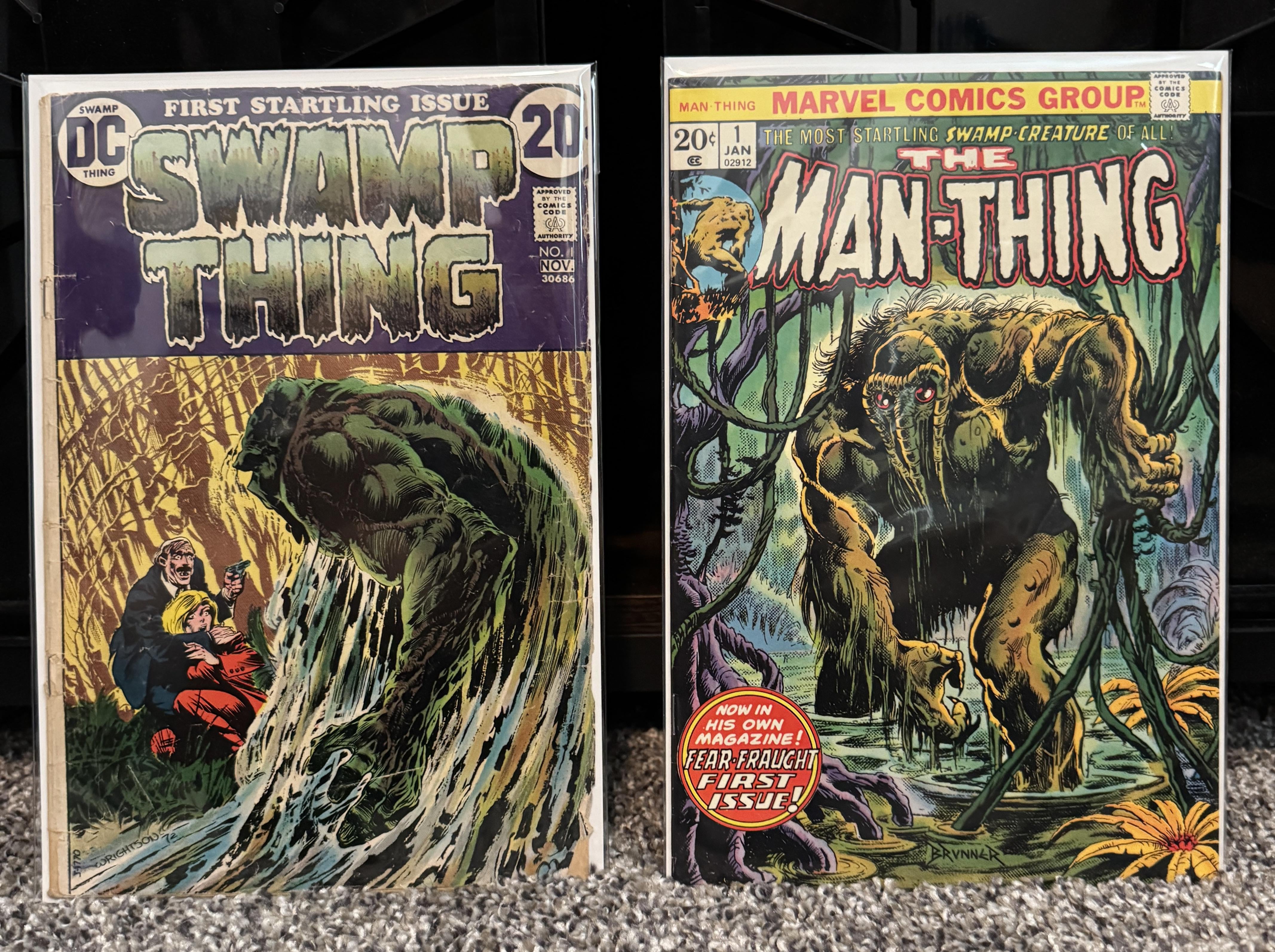
Two characters. The same swamp. Two months apart. No conspiracy.
Man-Thing and Swamp Thing: The Muck Was Already Waiting (1971)
21 June 2026 · Marvel
In August 1940, a writer named Theodore Sturgeon published a short story in a pulp magazine called Unknown. It was called “It!” and it described a creature that had formed, over decades, in a forest floor — vegetation and muck binding themselves around a human skeleton until something rose that was neither alive nor dead, neither animal nor plant. The creature had no malice. It simply moved, and destroyed things to understand them. The critic P. Schuyler Miller called it “probably the most unforgettable story ever published in Unknown.” It would go on to inspire a chain of imitations that runs unbroken to the present day.
Two years later, in December 1942, a character appeared in Air Fighters Comics #3. Created by writer Harry Stein and artist Mort Leav, he was Baron Eric von Emmelman — a German World War I flying ace, shot down over a Polish swamp in 1918. Rather than die, his will to survive kept him tethered to the earth as his body slowly merged with the vegetation over decades. He was called the Heap. He was practically mindless, shambling, and tragic. He was the first muck monster in comics, and he ran in Airboy Comics until 1953. He cast a shadow across the next thirty years that neither Marvel nor DC ever quite acknowledged.
By 1971 that shadow had grown very long.
Five Months
In March 1971, the publisher Skywald released Psycho #2 — a black-and-white horror magazine that revived the Heap for a new generation. Two months later, in May 1971, Marvel Comics published Savage Tales #1, introducing the Man-Thing. Two months after that, in July 1971, DC Comics published House of Secrets #92, introducing the Swamp Thing. Three swamp monsters in five months. The question of coincidence versus influence has been argued ever since, and the answer is messier and more interesting than either side admits.
Man-Thing was conceived in discussions between Marvel editor Stan Lee and writer Roy Thomas. Together they worked out five possible origins for the character. Lee provided the name — previously used for unrelated creatures in earlier Marvel anthology titles — and the core concept of a man losing sentience. Thomas worked out a detailed plot and handed it to writer Gerry Conway to script, with Gray Morrow providing the art.
Thomas was explicit about his source material. Unable to secure rights to revive the Heap — whose reprints had resurfaced that same year — he adapted the muck-creature archetype into Man-Thing: a scientist transformed via a botched Super-Soldier Serum experiment fused with the mystical energies of a Florida swamp. The character who emerged was Dr. Ted Sallis, a biochemist working on recreating the formula that had created Captain America. Ambushed by enemies, he injects himself with the unfinished serum and crashes his car into the Everglades. What surfaces is no longer Ted Sallis.
Swamp Thing arrived from a different direction. DC editor Joe Orlando contacted writer Len Wein for a last-minute eight-page backup story. Wein came up with the idea while riding a subway in Queens. He later recalled: “I didn’t have a title for it, so I kept referring to it as ‘that swamp thing I’m working on.’ And that’s how it got its name.” Bernie Wrightson had recently broken up with a girlfriend, and he and Wein were sitting in Wein’s car talking about life. Wrightson designed the character’s visual image from a rough sketch by Wein, completing the eight-page story in one weekend with assistance from Michael Kaluta — who also modelled for the story’s villain — and Jeff Jones, who inked two pages.
One thing needs to be stated clearly, because it trips up casual accounts of this history: the character in House of Secrets #92 was not Alec Holland. He was Alex Olsen, a scientist living sometime in the previous century, whose colleague Damian Ridge sabotages his laboratory to kill him and claim his wife Linda. The explosion buries Olsen in the swamp. Months later, something rises. It kills Ridge. Linda, saved by the creature, flees from it in horror, never realising that the monster who saved her was her husband. The story ends there. “The End.” Alec Holland (the Swamp Thing most readers know) would not appear until the full series launched in October 1972.
The Roommates
Here is where the story becomes something comics historians still argue about.
At the time Len Wein was writing that story for House of Secrets, his roommate was Gerry Conway, the man who had scripted Man-Thing’s first appearance. This is documented and undisputed. Wein later addressed it directly:
One of which is that I was rooming with Gerry Conway who wrote the first Man-Thing story. It was just independent creation. We were doing Swamp Thing and Gerry and I think Gray Morrow was doing Man-Thing. Neither of us knew the other was doing the same thing.
There is a further layer that Wein’s account does not mention. Wein himself wrote the second Man-Thing story, a piece commissioned for a planned second issue of Savage Tales that never appeared, and eventually published in Astonishing Tales #12 in June 1972. It was in that story that Roy Thomas, as plotter, introduced the concept that the emotion of fear was what triggered Man-Thing’s burning touch. Len Wein was, in other words, writing both swamp monsters simultaneously, and it was his work on Man-Thing that helped establish one of its defining characteristics.
Roy Thomas was not satisfied with the independent creation account. He later recalled: “Gerry was rooming with Len at the time and tried to talk him into changing the Swamp Thing’s origin. Len didn’t see the similarities, so he went ahead with what he was going to do. The two characters diverged off after that origin, so it didn’t make much difference, anyway.” Thomas confirmed there was vague talk at Marvel of legal action, though he did not know whether letters ever changed hands.
The reason that legal action never materialised is the richest irony of the whole story. Marvel’s case against DC would have required Marvel to explain in court where Man-Thing had come from, at which point the Heap’s lawyers, had anyone been paying attention, might have had something to say. Everyone had been fishing in the same pool. The lawsuit would have revealed the original act of borrowing in order to prosecute the imitation.
What They Actually Became
The origins are nearly identical, but the characters that emerged from them could not be more different.
Man-Thing stayed faithful to something close to Sturgeon’s original creation; a creature with no self, no memory, no agenda. Ted Sallis is gone. What remains is a large, slow-moving, empathic creature living in the Florida Everglades, serving as the unwitting guardian of the Nexus of All Realities — a point in the swamp where the barriers between dimensions are thin. He senses human emotions and is enraged by fear, automatically secreting a corrosive acid. Anyone feeling fear and clutched by Man-Thing burns.
The burning power was established in the original Conway story. The concept that fear specifically triggers it was developed by Roy Thomas in Astonishing Tales #12 and #13. But it was Steve Gerber who, in Adventure into Fear #11, his very first issue on the book, December 1972, coined the phrase that would define the character for fifty years: “Whatever knows fear burns at the Man-Thing’s touch.”
Gerber’s 39-issue run transformed the book into something genuinely unlike anything else Marvel was publishing. He used Man-Thing’s mindlessness as a lens rather than a limitation. Because the creature had no ideology, no agenda, and no capacity for judgement, Gerber could point him at the full complexity of human moral failure and let the reader draw their own conclusions. In one of his early issues, Man-Thing encounters a Black man on the run from a racist sheriff. Both radiate the same quality of fear-fuelled hatred. Man-Thing, indifferent, walks away, until fear becomes the only emotion left, and the tagline does its work. It was not a superhero story. It was about the futility of looking to a monster for moral clarity.
Swamp Thing followed a more conventional trajectory, the tragic monster, hunted outcast, seeking to reclaim his humanity until 1984, when Alan Moore arrived and dismantled the entire premise.
Moore’s first substantive act was to kill Swamp Thing. Then, in Saga of the Swamp Thing #21, February 1984, he had the body autopsied. The scientist performing the examination, Woodrue, the Floronic Man, hired by the Sunderland Corporation discovers that every organ inside Swamp Thing is a vegetable facsimile with no functional role. The conclusion is devastating: Alec Holland died in the explosion. A plant entity absorbed his memories and bioelectric imprint, constructed a copy of his consciousness, and believed itself to be human. Swamp Thing was never Alec Holland. He cannot be cured and become Alec Holland again, because he never was Alec Holland.
Moore later explained the creative logic: the original premise had trapped the character in an endless loop of seeking a cure that could never arrive without ending the series. Removing the possibility of cure removed the limitation. But the philosophical consequences ran deeper than a plot fix. A being that believes it was human, carries a human’s grief and love and memory, but is materially and causally entirely plant; what is it? What does it owe to humanity? What does humanity owe to it? These are not questions Man-Thing can ask. Swamp Thing has spent forty years asking them.
The Full Chain
It is worth tracing the lineage completely, because it reveals something true about how stories travel through culture.
Theodore Sturgeon imagined a creature in a forest floor in August 1940. Two years later Harry Stein and Mort Leav put a German pilot in a Polish swamp and called the result the Heap. That character ran until 1953. In 1971 its reprints resurfaced at the exact moment three publishers were independently reaching for the same archetype. Roy Thomas drew directly on the Heap and acknowledged it. Len Wein almost certainly knew it too — he was sharing an apartment with the man who had just written a version of it, and had himself written a second version of it.
What none of them could control was what happened once other writers arrived. Gerber turned Man-Thing into a vehicle for social criticism, existential horror, and eventually the birth of Howard the Duck. Moore turned Swamp Thing into one of the most philosophically ambitious runs in the medium’s history, introduced John Constantine, and laid the groundwork for DC’s Vertigo imprint. Neil Gaiman cited Gerber’s Man-Thing as a direct influence before he later wrote Swamp Thing himself. The lineage keeps moving.
Both characters emerged from the same source material, through writers who were sharing an apartment, into a cultural moment — Earth Day just passed, ecological anxiety peaking, the Comics Code loosening its grip on horror — that was primed for swamp monsters. Both became something their origins could not have predicted.
The swamp in American mythology is the place where things rot, transform, and return in forms nothing like what they were. It is the landscape of the unconscious, of what refuses to stay buried. The muck monster keeps erupting from it because the archetype keeps finding new things to mean.
Sturgeon understood that in 1940. He just did not know he was writing the founding document of a genre.