Story from the Vault
Kraven's Last Hunt (1987)
8 August 2026 · Marvel
I came out of Spider-Man: Brand New Day last week in that strange, slightly sheepish mood that most superhero films leave me with at the moment. An OK, fun romp about a man-boy in pyjamas. The reviews have all converged on the same word, more or less: grounded. Critics have been praising it for cutting out the multiverse nonsense and getting back to the city, to the friends, to the apartment, to the rent. Someone said Holland has finally nailed the angst and the love hassles the way Lee first drew them up. And the thing everyone seems to agree is that it works because Peter is a person rather than a myth.
…so naturally I went home and pulled Kraven Last Hunt off the shelf, because I am an adult with hobbies.
And I've been reading it all week with a growing sense that we, collectively, the whole of comics fandom and me very much included, have had this book filed on the wrong shelf since about 1988.
The story that didn't want to be a Spider-Man story
Kraven's Last Hunt was rejected three times before anybody thought of Spider-Man, and it was rejected a fourth time in spirit when the villain turned out to be someone else entirely. J.M. DeMatteis has written about this on his own blog more than once, and the sequence is genuinely funny in the way that only publishing can be.
It started around 1984 or '85 as a Wonder Man miniseries. Simon Williams gets done in by his brother the Grim Reaper, wakes up in a coffin, claws his way out, and discovers he's been down there for months. Tom DeFalco, then Marvel's executive editor, took one look and said no.
So DeMatteis carried it over to DC as a Batman story, and this version is the one that makes you sit up. The Joker kills Batman (or believes he does) and with the entire reason for his existence removed, his mind snaps in the only direction left available to it. He goes sane. Meanwhile Batman is clawing his way up through the dirt, about to walk back into the world and unmake the Joker's fragile new life all over again. It's a brilliant pitch. Len Wein turned it down because he already had a Batman-and-Joker story on his desk by some new British bloke called Alan Moore, and the elements overlapped. That story was The Killing Joke. DeMatteis, to his eternal credit, has since described Moore in print as "a new British writer... what ever happened to him, anyway?"
Undeterred, he swapped the Joker for Hugo Strange, remembering a couple of pages in an Englehart-Rogers story where Strange had put on the Batman costume, and thinking: what if he killed Batman and then became him, out of sheer ego, to prove he could do it better? Denny O'Neil, who by then had taken over the Bat-books, also said no. Three rejections, three of the best editors in the business, and DeMatteis has admitted he briefly wondered whether he was simply delusional.
Then in autumn 1986 Jim Owsley (the editor who ran the Spider-Man line, and who you'll know better today as Christopher Priest) took him to lunch with DeFalco and strong-armed him into writing Spectacular Spider-Man. He didn't want another monthly. They pushed. He caved. And on the way home he realised he'd just been handed one final go at the buried-alive idea.
The villain, at that point, was a brand new character DeMatteis invented for the job and has since completely forgotten, name and all. Kraven only turns up because DeMatteis was sitting in his office avoiding work, flipped open an Official Handbook of the Marvel Universe, landed on Kraven's entry for no reason whatsoever, and clocked one detail: the man was Russian. He's been perfectly open about the fact that he'd always thought Kraven was one of the dullest villains in the gallery, nowhere near Ock or the Goblin. But Russian meant Dostoyevsky, and Dostoyevsky had taken a chunk out of him as a teenager, and in that instant the whole thing reorganised itself. He rang Owsley and told him to bin the new villain. Owsley, who liked the new villain, let him do it anyway.
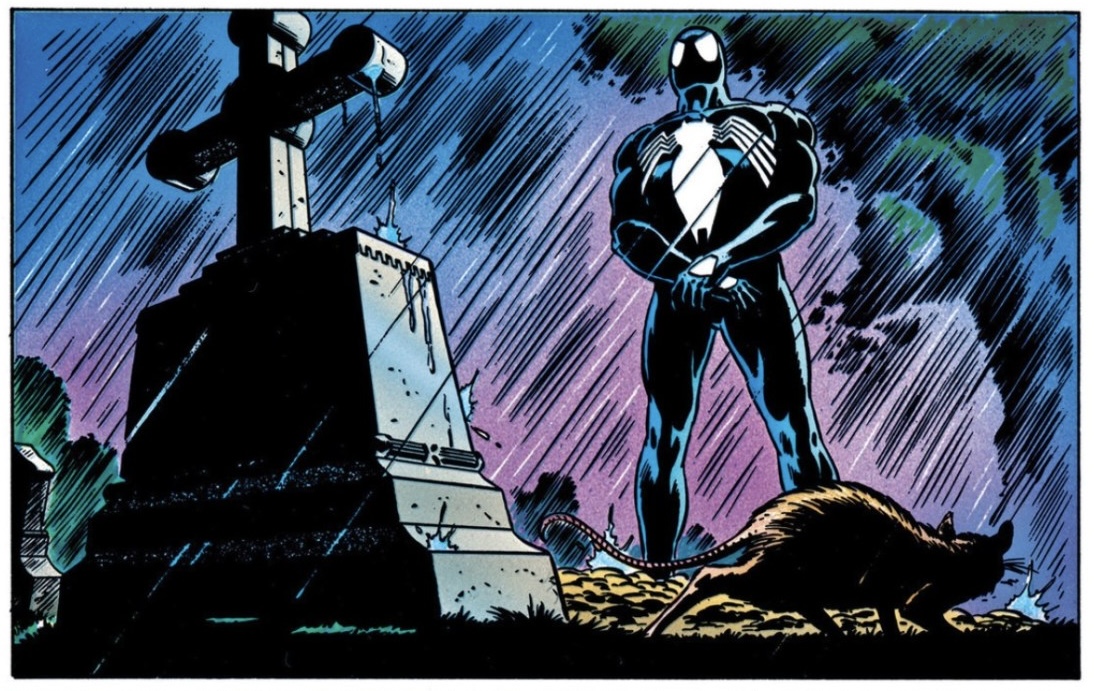
Vermin arrives even later, and for an even more mundane reason: Mike Zeck was on the book, DeMatteis and Zeck had cooked up the man-rat together on Captain America, and it seemed a shame not to use him. That casual bit of housekeeping turns out to be the load-bearing wall of the entire story.
Not one element of the most celebrated Spider-Man story ever told was planned. The costume came from a fan's idea Marvel bought for $220. The marriage came from an offhand Stan Lee remark at a convention that Jim Shooter took seriously. The crossover format came from Jim Salicrup worrying that readers would find it odd if Peter were buried alive in one title and cheerfully fighting Doc Ock in another. And the whole thing sailed through because Shooter had been fired that April and Marvel management was too busy imploding to pay attention to any one comic.
Much of that detail, I should say plainly, comes from a single source: a write-up of a 2017 anniversary panel at East Coast Comicon, where DeMatteis, Zeck, Bob McLeod, letterer Rick Parker and Salicrup all sat down together, transcribed afterwards by the fan and commentator Thomas Mets. It's careful, it squares with everything DeMatteis has said elsewhere, and I have no reason at all to doubt it — but it is one person's account of one afternoon, and you should know that when you read the good bits. The good bits include Salicrup posting the script to Stan Lee, who replied, essentially, that it wasn't something he would have done but it was really rather good. Which is about as Stan as a sentence can get.
The misreading
Right. Here's where I get argumentative.
Ask the hardcore to place Kraven’s Last Hunt and they'll put it in the same sentence as Watchmen and The Dark Knight Returns. Marvel's answer to the grim turn. The year the webhead grew up and got miserable. It's in every anniversary listicle and it's the first thing the algorithm will tell you.
DeMatteis has been asked this directly, on a stage, with the rest of the creative team sitting next to him, and said flatly that it had nothing to do with either book.
And once you take him at his word, the thing snaps into a completely different shape, because Last Hunt is not a dark Spider-Man story. It is a story about a man who mistakenly believes Spider-Man is a dark Spider-Man story, and who destroys himself on the rocks of that misunderstanding.
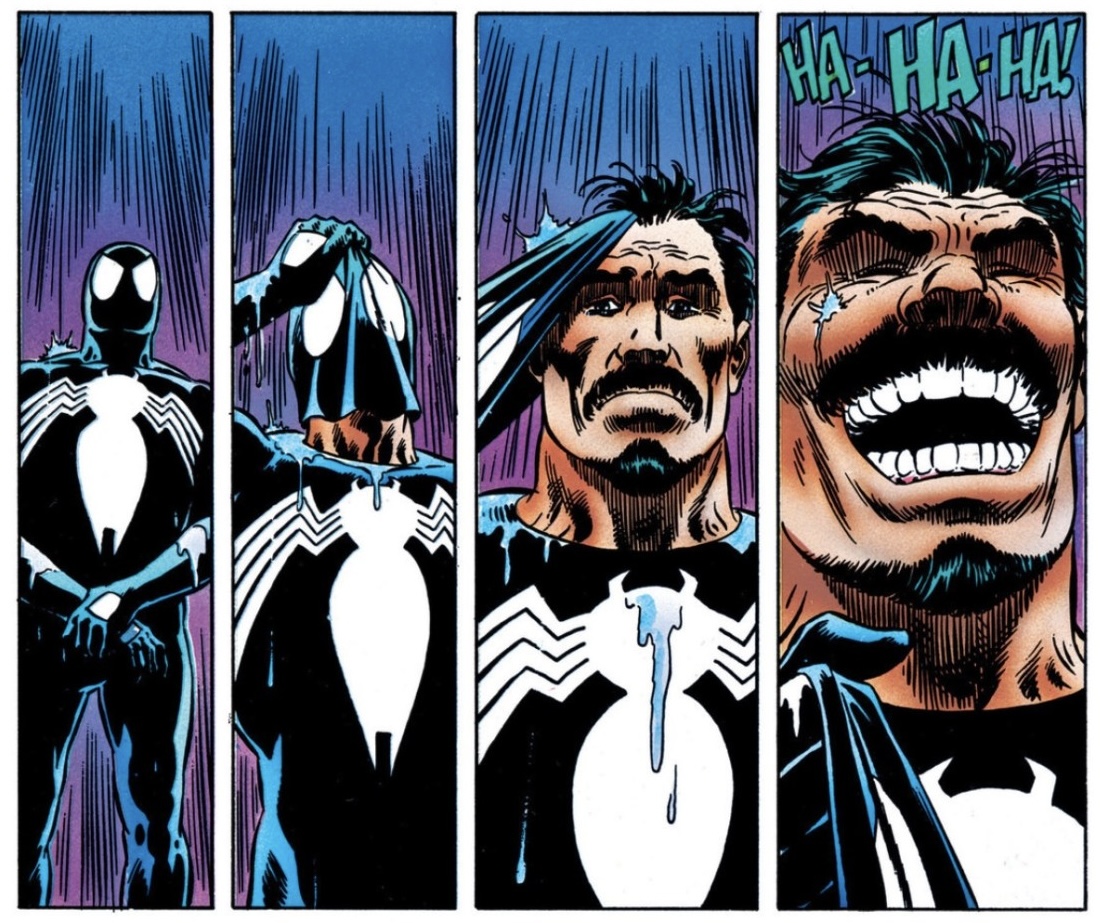
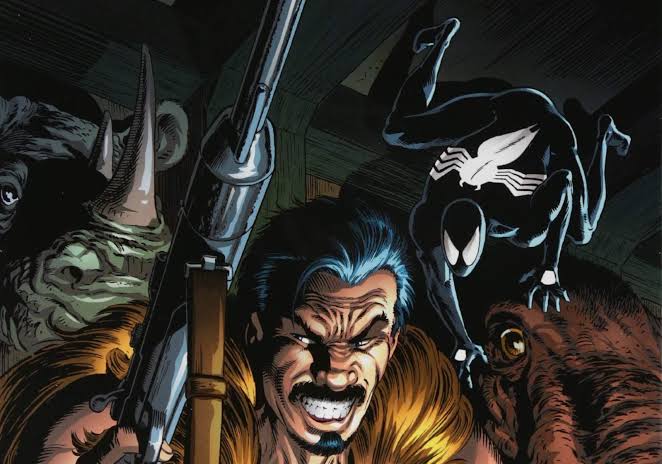
That's the whole plot. Kraven doesn't want to kill Spider-Man; he wants to be him, and the version of him he sets out to be is a nocturnal predator, a thing of teeth and shadow and violence, essentially Frank Miller's Batman with better upper-body strength. He puts on the suit. He hunts. He brutalises criminals in a way the real man never would. He goes down into the sewers and beats Vermin bare-handed, the one opponent Spider-Man had needed Captain America's help to take. By his own metrics he wins outright.
DeMatteis said it out loud in an interview a full year before publication: what Kraven becomes isn't Spider-Man, it's what Kraven perceives Spider-Man to be, and the point is that Peter never becomes a dark creature of the night no matter what he's wearing, because underneath he stays a decent, worried, passionate bloke. Kraven doesn't know that. It's not stated as subtext. It's the thesis.
And the story is built to hammer it home. Blake's tiger, with "Tyger" swapped for "Spyder", isn't decoration — the poem is famously about a poet's inability to comprehend the creature he's describing, which makes it the single most appropriate epigraph anyone has ever bolted onto a superhero comic. Kraven quotes it at us for six issues while demonstrating that he hasn't understood a word of it. And the book ends, as one of DeMatteis's own readers pointed out to him years later, in daylight — Peter, having crawled up out of the earth on the strength of nothing more mystical than loving his wife, chooses to go and help the sad broken thing in the sewer rather than take his revenge. DeMatteis's reply to that reader was that there's no point to the story at all without the inescapable light at the end of it.
So: the most influential grimdark superhero comic of the eighties is a sustained argument against grimdark superhero comics. Forty years of imitators have copied the grave and skipped the sunrise. And the most expensive misreading of the lot cost Sony a hundred and ten million dollars in 2024 — a Kraven the Hunter film that took "thematic inspiration" from this story and arrived at a man with a crossbow and a fifteen percent Rotten Tomatoes score. They filmed the mask and lost the face. Kraven would have loved it.
Which brings me back to Brand New Day, and a Spider-Man film currently being congratulated for being grounded, emotional and human. For understanding, in other words, exactly what Sergei Kravinoff went to his grave not understanding.
Postscript: the pages
One last thing, and this one is a bit close to home for me.
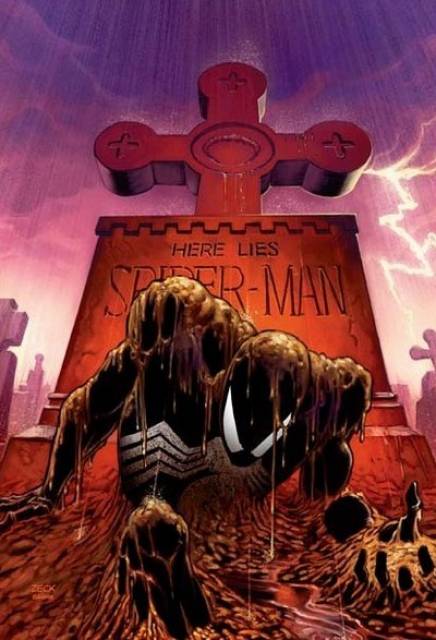
The original artwork for Kraven's Last Hunt survived intact for years. It was even displayed in a museum for a time. Then it went to a private collector, who kept the six covers — including Zeck's "Resurrection", that image of Spider-Man hauling himself out of his own grave that half of you have as a phone wallpaper — and sold every single interior page off individually. Zeck reckons this happened roughly a year before Artist's Editions took off. Another twelve months of somebody paying attention and the whole book would have been preserved in facsimile forever.
A story about a man buried alive, stripped of his name, and scattered. Dismembered and sold off in pieces because nobody was keeping track.
I build a thing for keeping track. You can see why I took it personally.
Sources I dipped into:
J.M. DeMatteis, “The Story Behind the Hunt — 2017”, Creation Point (personal blog), 10 June 2017. https://www.jmdematteis.com/2017/06/the-story-behind-hunt2017.html
Thomas “Mister Mets” Mets, write-up of the Kraven’s Last Hunt 30th anniversary panel, East Coast Comicon 2017. Posted to the CBR Community forums, 10 June 2017. https://community.cbr.com/threads/kravens-last-hunt-fearful-symmetry.64543/page-2
Jim Salicrup and Dwight Jon Zimmerman, “J. Marc DeMatteis (part 3)”, Comics Interview #40, Fictioneer Books, November 1986, pp. 6–21.
“Kraven’s Last Hunt”, Wikipedia https://en.wikipedia.org/wiki/Kraven%27s_Last_Hunt
Popverse, “Joker’s Last Hunt: The rejected Batman story that became a Spider-Man classic”, 2025. https://www.thepopverse.com/comics-spider-man-kravens-last-hunt-batman-rejected-story-going-sane-j-m-dematteis
Christopher Priest / Jim Owsley, Wikipedia. https://en.wikipedia.org/wiki/Christopher_Priest_(comic_book_writer)
Julian Darius, “The Panther’s Priest: Christopher Priest’s Career Prior to Black Panther”, Sequart Organization. http://sequart.org/magazine/70566/christopher-priest-career-prior-to-black-panther/
Popverse, “Marvel Comics fires their longtime boss Jim Shooter in 1987”. https://www.thepopverse.com/comics-made-in-87-jim-shooter-marvel-fired
Chris Sims et al., “The Artist’s Spider-Man: The Moody Atmosphere of Mike Zeck”, ComicsAlliance, 2016. https://comicsalliance.com/artists-spider-man-mike-zeck/ Randy Schueller’s 1982 fan submission and Jim Shooter’s $220 purchase of the black costume concept.
Variety, “Box Office: Kraven the Hunter Bombs With $11 Million Opening Weekend”, 15 December 2024. https://variety.com/2024/film/news/box-office-kraven-the-hunter-bombs-worst-start-sony-marvel-films-1236247536/