Story from the Vault
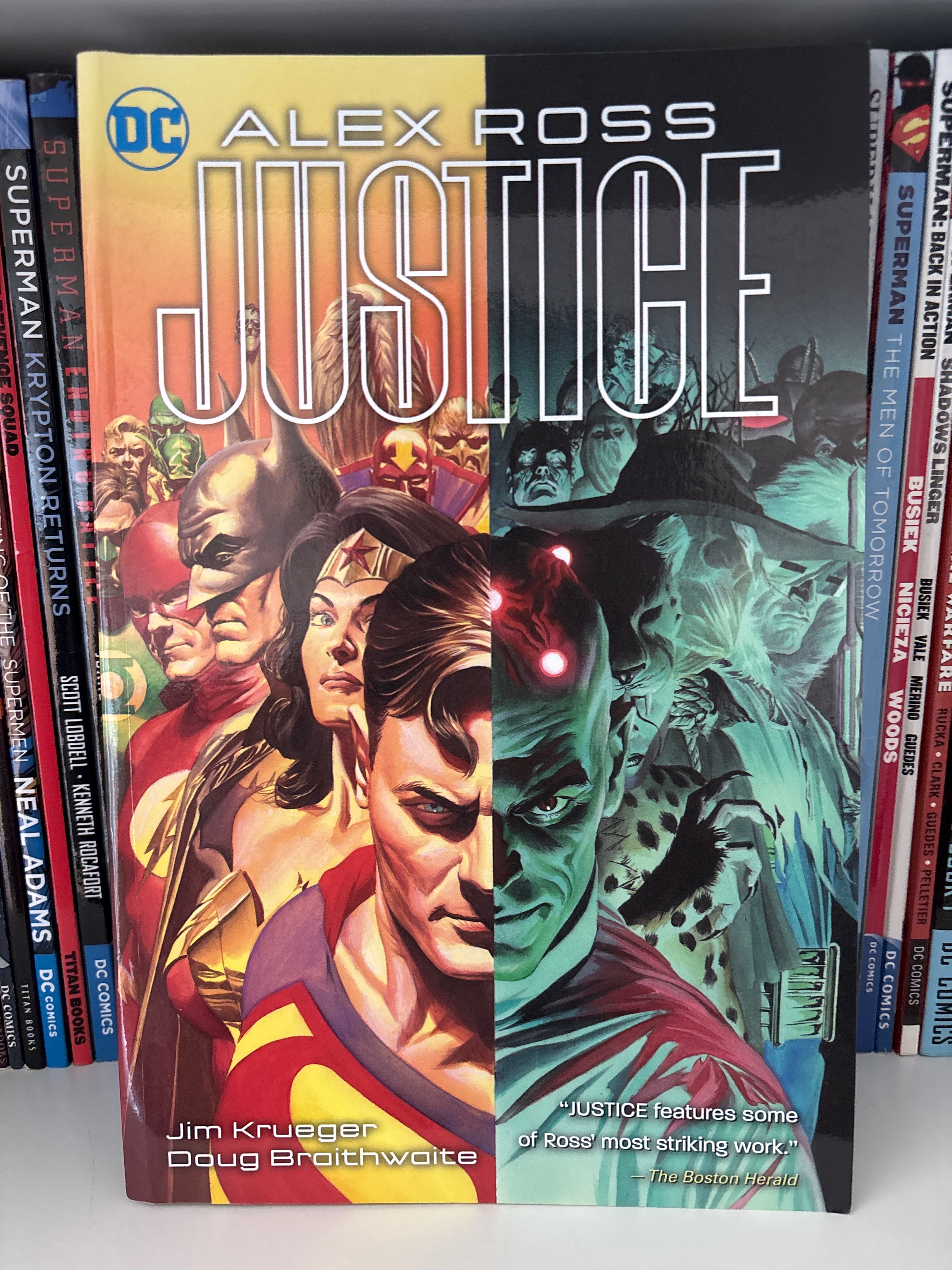
Justice - Collected Edition (2011)
22 February 2026 · DC Comics
Pick up DC’s 2011 collected edition of Justice and the first impression is almost physical before it is intellectual. This is a superhero comic that wants to be held like a ceremony. The capes have weight, the shadows have a cathedral hush, and every familiar symbol seems polished until it catches the light from some remembered Saturday morning. Superman does not simply stand in these pages; he arrives, all red, blue, and impossible decency, as if the whole idea of the Justice League had been waiting for a painterly spotlight.
That grandeur matters, because Justice is a book about icons under siege by other icons. It takes the clean, elemental appeal of DC’s greatest heroes and sets it against the equally vivid appeal of their enemies, then asks a sly question. What happens when the villains decide they can save the world more effectively than the heroes? The result is one of the most lavish Justice League stories of the modern era, a comic that feels old-fashioned in the best sense, yet too psychologically restless to be mere nostalgia.
A collected vision from a particular DC moment
The original Justice series was published by DC Comics as a twelve-issue limited series beginning in 2005 and concluding in 2007, at a time when the publisher’s superhero line was thick with continuity stress, moral compromise, and event-scale consequence. Identity Crisis, Infinite Crisis, and the wider mood of the mid-2000s DC Universe had left readers thinking hard about trust, surveillance, legacy, and the cost of heroism. Justice stood slightly apart from that machinery. It was not a chapter to be filed between crossovers so much as a grand, self-contained stage production using the most recognizable versions of the characters.
The 2011 collected edition is important because it lets the work breathe as one long argument rather than a sequence of handsome installments. In single issues, the series had the stately pace of a bimonthly prestige project. In one volume, its shape becomes clearer. The dreams, betrayals, rescues, and reversals gather momentum; the rogues’ plan feels less like a villain-of-the-month parade and more like a coordinated ideological assault on the Justice League’s moral authority.
DC has always understood the value of repackaging its major superhero works for new readers, and Justice benefits especially from that treatment. It is a book for readers who know the League through comics, animation, lunchboxes, or sheer cultural osmosis. Its roots reach back toward the Bronze Age, the Challenge of the Super Friends version of the Legion of Doom, and the bright clarity of classic superhero conflict, but the finish is unmistakably modern. The collected edition turns that mixture into a handsome object, the kind of book that sits comfortably beside Kingdom Come, The New Frontier, and other DC volumes built around the romance of the superhero idea.
Ross, Krueger, Braithwaite, and Klein at full scale
Justice is often spoken of as an Alex Ross book, and understandably so. Ross brought to it the visual authority that had already made Marvels and Kingdom Come landmarks. His sensibility is central here, not only in the painted finishes and designs, but in the very premise, which treats the DC pantheon as something both beloved and breakable. Ross has long had a gift for making superheroes look like public monuments inhabited by private anxieties. In Justice, that gift is pointed not at the fall of heroes, but at the fear that the world may stop believing it needs them.
Jim Krueger, who had collaborated with Ross before, gives the project much of its narrative architecture and voice. His writing leans into the operatic, yet he keeps returning to motive. The villains are not softened into misunderstood saints, but neither are they merely cackling masks. Lex Luthor, Brainiac, the Joker, Gorilla Grodd, Sinestro, Black Manta, Cheetah, and others become a chorus of wounded egos and sharpened grievances. They have seen disasters in their dreams, and from that shared nightmare they build a campaign that looks, at first glance, disturbingly benevolent.
Doug Braithwaite’s contribution is sometimes under-discussed, which is a shame, because the book depends on his structural strength. His pencilling gives the figures their mass, their staging, their sense of physical contact with the page. Ross’s finishes can make an image glow, but Braithwaite grounds the action so that the spectacle has bones under it. A lesser visual foundation might have turned the series into a gallery of beautiful posters. Braithwaite helps make it sequential storytelling, with bodies moving through rooms, battles unfolding across space, and quiet confrontations landing with dramatic force.
Then there is Todd Klein, one of the great letterers in American comics, whose work here is the sort of craft readers may feel before they notice. In a book crowded with gods, monsters, machines, speeches, broadcasts, and internal dread, lettering becomes a matter of orchestration. Klein’s placement and clarity help guide the eye through pages that could easily become overwhelming. He gives the voices room inside the art without bruising the art’s grandeur, which is no small thing when nearly every panel seems built to be admired.
The League, the villains, and the collector’s pull
The story begins with a shared vision of catastrophe. The world ends, the heroes fail, and the villains wake with a new sense of purpose. Rather than attack the Justice League directly at first, they begin curing disease, feeding the hungry, healing the wounded, and solving problems the heroes have never fully been able to solve. Luthor and his allies understand something poisonous and effective about public faith. If they can make the League look reactive, limited, and even obsolete, then victory can arrive before the first real punch is thrown.
Superman sits near the emotional center of that challenge. He represents the League’s promise in its purest form, the belief that power can be joined to restraint and compassion. Yet Justice is careful not to make him the only pillar. Batman’s suspicion, Wonder Woman’s resolve, Aquaman’s dignity, the Martian Manhunter’s melancholy intelligence, Green Lantern’s will, the Flash’s decency, and Captain Marvel’s innocence all matter to the larger design. The book loves the whole team, including the members who can sometimes be treated as secondary in modern retellings.
What makes the cast sing is the way each hero is paired, directly or indirectly, with a nightmare reflection. Black Manta’s hatred of Aquaman is not interchangeable with Sinestro’s contempt for Green Lantern or Luthor’s obsession with Superman. The villains’ plan works because it is personal on a dozen fronts at once. Their coalition has the lurid pleasure of a toy shelf brought to life, but Krueger and Ross keep pressing on the moral rot beneath the spectacle. These people want to save the world only if doing so proves that they were right all along.
Reception to Justice has always been tied to expectation. Readers who wanted a tight, contemporary League thriller sometimes found its pace grander than swift. Readers attuned to Ross’s affection for classic DC iconography often embraced it as one of the most beautiful love letters the Justice League has received. Over time, the book has settled into a distinct place in the canon, not as a continuity cornerstone, but as a definitive bookshelf statement about what these characters feel like when treated as modern myth without irony.
For collectors, the appeal is easy to understand. The 2011 collected edition gathers a visually sumptuous series in a form that is far easier to revisit than scattered single issues, and it captures a creative team working in a mode that has become increasingly rare. Large-cast superhero comics are common, but large-cast superhero comics with this level of polish, patience, and unapologetic sincerity are not. It is also one of those volumes that rewards casual browsing. Open it almost anywhere and some image will stop you, a glare from Luthor, a wounded hero under impossible light, the League assembled like a promise the world is still deciding whether to trust.
Justice endures because it understands the strange bargain at the heart of DC’s greatest heroes. They are simple enough for a child to recognize from across a room, yet durable enough to carry adult fear, doubt, and longing. The 2011 collected edition preserves that balance in a generous, accessible form. If your shelf has room for one Justice League story that treats the team not as a brand or a battlefield, but as an idea worth defending with every ounce of craft available, this is a book to seek out and linger over.