Story from the Vault
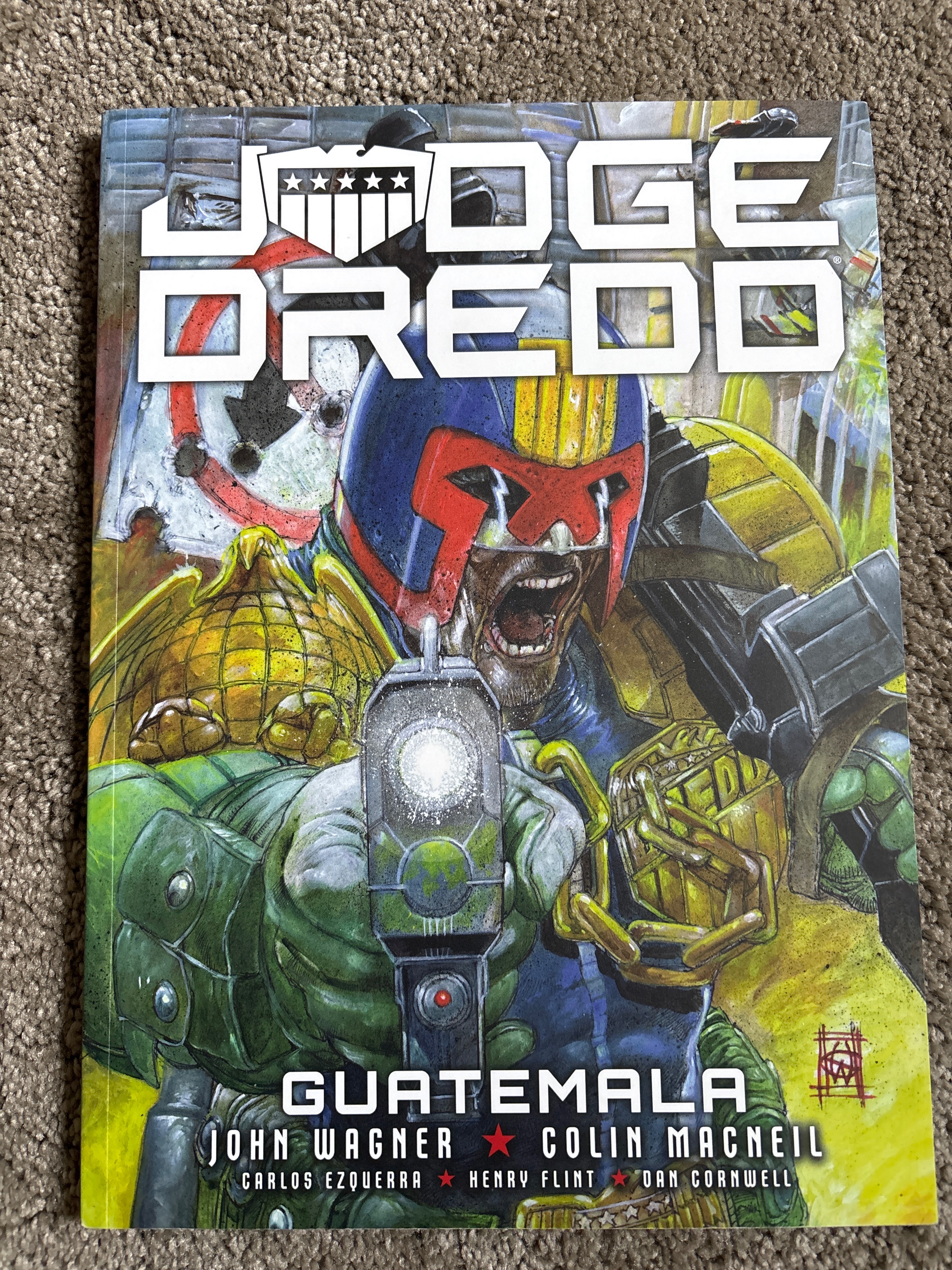
Guatemala (2021)
20 March 2026 · 2000AD
Pick up Guatemala and the first thing you feel is not novelty, but pressure. This is a Judge Dredd book with a long memory, the kind that seems to carry half a century of Mega-City One in its spine before you have even turned the first page. Dredd has always been a future cop built out of contradictions, a fascist joke who became a strangely reliable moral instrument, a man without private life who somehow gathered emotional weight through the lives he damaged, saved, or outlasted. By 2021, that weight had become part of the reading experience. A new Dredd collection was no longer simply another patrol through the Big Meg. It was a return to a city that had survived wars, plagues, coups, judicial paranoia, democratic unrest, robot revolts, and its own terrible instincts.
That is why Guatemala lands with such particular force. It is not a beginner’s sampler, though a new reader can understand the shape of its conflicts quickly enough. It is late-period Dredd, written with the confidence of creators who know how little they need to explain when the city itself is doing so much talking. The streets, the lawgiver, the sour comedy, the procedural rhythms, the sudden cruelty, they are all familiar. What has changed is the sense of age. Dredd is still moving forward, but the strip around him keeps looking back, asking what justice means when the institutions administering it have left such a long trail behind them.
A 2000 AD book with history under the cover
Guatemala was published by 2000 AD in 2021, under the Rebellion banner, as part of the modern line of collected Judge Dredd volumes that bring together serial material for the bookshelf. That matters more than it might sound. Dredd was born for weekly rhythm, for the sharp hit of an episode in 2000 AD, a few pages of satire, action, absurdity, or horror that could still leave a bruise. Collected editions change the temperature. They let the reader feel patterns that might be separated by weeks in their original form, and they show how carefully later Dredd stories have been shaped to echo earlier ones without simply embalming them.
The book arrived in a period when 2000 AD was looking both backward and forward with unusual assurance. The comic had already passed its fortieth anniversary, and Dredd himself had moved far beyond the stage where he could be treated as a simple action property. The long-running strip had accumulated consequences. The Apocalypse War still mattered. Necropolis still mattered. The failures of the Justice Department still mattered. The rise of robot judges, the aftermath of Chaos Day, the question of whether Mega-City One could survive the people sworn to protect it, these were not background references for the faithful. They were active ingredients.
In that context, a book like Guatemala belongs to a distinctive strand of modern Dredd. It is concerned with the machinery of power as much as with the chase or the shootout. The title itself suggests a world beyond the city walls, and Dredd has always become especially revealing when taken out of his usual jurisdiction. Mega-City One is a pressure cooker, but the wider world of Judge Dredd is a map of old atrocities and political arrangements that have curdled into custom. Whether the story is in the Cursed Earth, another city-state, or a territory scarred by earlier conflicts, Dredd carries the law with him like a weapon and a curse.
Wagner, Ezquerra, and the hands that shape the law
The creative roll call on Guatemala is enough to make a Dredd reader sit up straighter. John Wagner is here, and that alone gives the collection its centre of gravity. Wagner’s relationship with Dredd is one of the great long-form acts of authorship in British comics. With Carlos Ezquerra, he helped create the character, and across decades he refined the strip into something far stranger and more durable than its original premise might have promised. Wagner’s Dredd dialogue has a hard, dry economy. His satire can be grotesque, but he rarely loses sight of procedure, motive, and consequence. He understands that the funniest Mega-City One gag is often only a step away from tragedy.
Carlos Ezquerra’s presence in the credits carries a different emotional charge. Ezquerra’s design language is baked into Judge Dredd, from the helmet and eagle to the grimy density of the city itself. His Dredd was never clean futurism. It was lived-in, greasy, crowded, and faintly dangerous even in quiet panels. Seeing his name on a 2021 collection is a reminder that modern Dredd is still in conversation with its foundations. Ezquerra died in 2018, and any later collected volume that includes his work inevitably reads with that knowledge in the room. The pages do not need to become a memorial to feel touched by farewell.
The other artists named on the book show the breadth of Dredd’s visual grammar. Colin MacNeil brings authority, mood, and a gift for faces that seem to have endured too much. He can make Justice Department corridors feel like sacred architecture one moment and bureaucratic concrete the next. Henry Flint gives the strip elastic violence and manic civic scale, with a sense of motion that can make a page feel as if the city has burst its banks. Dan Cornwell has become one of the most persuasive modern inheritors of the classic Dredd line, sharp, muscular, and comfortable with both grim comedy and hard action. Will Simpson, long associated with painted and atmospheric comics work, adds another texture to the lineage, reminding us how adaptable Dredd can be without losing its shape.
Letterer Annie Parkhouse is one of those names collectors have learned to respect because the reading experience depends so heavily on her clarity. Dredd stories are dense with commands, radio chatter, judicial jargon, and punchline timing. If the lettering is wrong, the whole city stumbles. Chris Blythe’s colours, likewise, help modern Dredd keep one foot in the lurid pop tradition of the weekly and another in a darker, more cinematic register. Colour in late Dredd has to do more than decorate. It guides tone, separates satire from horror, and gives metal, blood, sky, and concrete their own emotional values.
The case file, the city, and the aftertaste
The stories gathered under the Guatemala banner circle the familiar figure of Judge Dredd, but their interest lies in the friction between his certainty and the world’s refusal to become simple. Dredd is not a detective who discovers himself through a case. He is, by design, almost immovable. The drama comes from watching that immovable object enter situations where law, politics, vengeance, and survival have knotted together over years. He can identify guilt. He can pass sentence. What he cannot always do is cleanse the system that produced the crime in the first place.
That makes the supporting world essential. In late-period Dredd, Justice Department is never merely the good guys’ headquarters. It is an institution full of brilliant operators, frightened pragmatists, zealots, cynics, reformers, and loyal servants who may be loyal to a terrible idea. The city’s citizens, meanwhile, remain the strip’s wild chorus. They are victims and fools, consumers and rebels, cowards and accidental prophets. Wagner has always understood the citizens of Mega-City One as more than comic relief. Their madness is often a rational response to an unlivable society.
The title story’s pull comes from that larger political imagination. Dredd stories set away from the central sprawl often reveal how exported law, old conflicts, and imperial habits distort everything they touch. The future in 2000 AD is not cleanly invented from scratch. It is our own world exaggerated, damaged, and renamed, with the old inequities still visible beneath the science fiction hardware. Guatemala uses that method well. The specific pleasures are those of the case file, the mission, the confrontation, but the aftertaste is historical. The book asks the reader to think about how violence is archived, who gets to call an atrocity finished, and whether the law can ever stand outside the politics that deploy it.
As a collected volume, Guatemala also appeals because it places several major Dredd hands in proximity. Collectors often chase books like this for reasons that go beyond plot. There is the Wagner factor, of course, since his late Dredd work has an austere fascination. There is Ezquerra, whose connection to the character gives any inclusion added significance. There is the chance to see MacNeil, Flint, Cornwell, Simpson, Blythe, and Parkhouse contribute to the continuing shape of the strip. For a shelf of Dredd trades, Guatemala is not just another spine with a stern helmet on it. It is a marker of continuity, proof that the strip’s founding DNA and its modern craft can still speak to one another.
Reception to late Wagner Dredd has often centred on that very quality. Readers who have lived with the character for decades tend to value the sense that consequences are still being counted, that Mega-City One has not been reset into a toybox where nothing matters. Newer readers may find the density intimidating at first, but Dredd has a useful way of teaching you how to read it. The uniform tells you the surface. The city tells you the joke. The ending, more often than not, tells you the cost.
If you come to Guatemala looking for a bright entry point, you may find instead a room full of old case files, each one stained at the edges. That is part of its appeal. This is Judge Dredd as institutional memory, as political satire, as hard-faced adventure with a conscience it refuses to name too loudly. Seek it out for Wagner’s control, for the artists’ varied command of a brutal future, and for the pleasure of watching 2000 AD do what it has done so well for so long: take a ridiculous world deadly seriously, then make the seriousness feel ridiculous, then leave you wondering why the joke hurts.