Story from the Vault
Descender (2015)
5 February 2026 · Image Comics
There is a particular hush to Descender when you open it, the kind that makes a reader handle the book a little more carefully than expected. Dustin Nguyen’s pages do not come at you like polished chrome. They bloom and bleed. Planets sit in pale washes of color, cities glow as if remembered through smoke, and the little robot boy at the center of it all, TIM-21, looks less manufactured than found. He has the round-eyed vulnerability of a lost child in a storybook, which is exactly why the book works. For all its starships, bounty hunters, galactic councils, and machine gods, Descender begins with the oldest feeling in adventure fiction, a child waking up alone in a world that has decided he is dangerous.
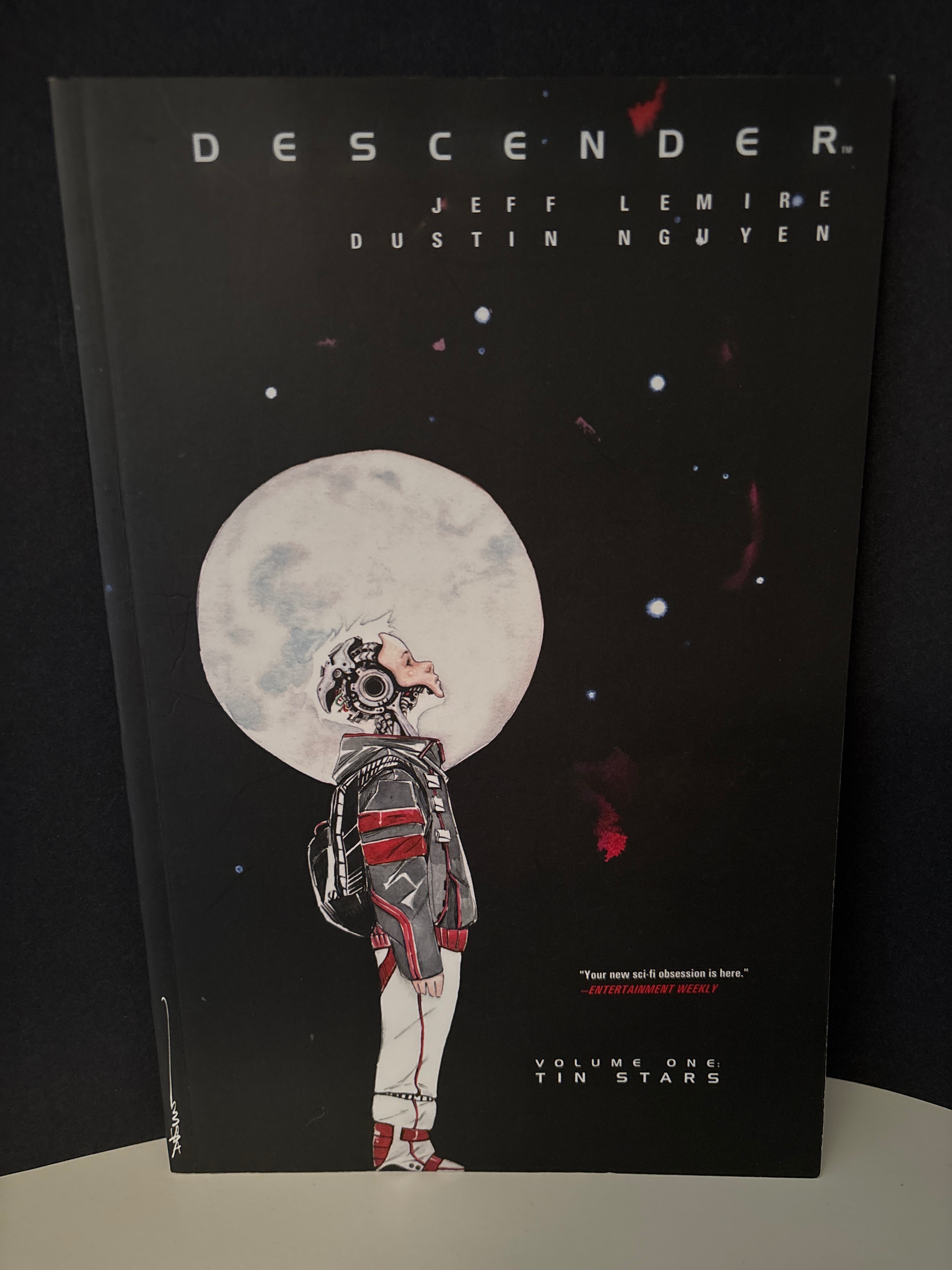
Image Comics published Descender in 2015, with the first volume, Tin Stars, collecting the opening six issues later that year. It arrived during one of Image’s great modern periods, when the publisher had become the most exciting address in American creator-owned comics. The shelves around it were filled with ambitious, adult genre work: science fiction, crime, horror, fantasy, family drama in superhero clothing, and strange hybrids that would have struggled to find oxygen in a more cautious market. Saga had helped prove that a personal, emotionally direct space opera could become a genuine comics phenomenon. Books like East of West, Black Science, and Lazarus were showing how hungry readers were for worlds that felt vast but authorial, built less by committee than by obsession.
Into that atmosphere came Descender, a monthly series that looked unlike almost anything else on the rack. The format was familiar enough, a standard Image single issue with collected editions to follow, but the texture was striking. In an era when much mainstream genre art leaned into digital finish and cinematic sheen, Nguyen’s watercolor approach gave the book a fragile humanity. It looked handmade, which mattered enormously in a story about artificial beings, manufactured life, and the terror of not knowing where personhood begins.
A creator-owned space opera with a handmade pulse
Jeff Lemire came to Descender with a reputation for intimacy as much as imagination. By 2015, he had already built a body of work that moved comfortably between the quiet ache of Essex County, the post-apocalyptic tenderness of Sweet Tooth, and the strange formal confidence of books like Trillium. He had also spent time writing major superhero properties for DC and Marvel, which gave him a sharp sense of how to handle momentum, cliffhangers, and ensemble casts without losing the emotional line through a story. Lemire’s best work often turns on loneliness, family, memory, and the things people do when the world has already broken them. Descender gave him an enormous canvas, but he did not begin with galactic politics. He began with a boy.
Dustin Nguyen, meanwhile, had long since proved himself one of the most versatile artists of his generation. Readers knew him from sleek, kinetic superhero work, especially in the Batman corner of DC, and from projects that showed a lighter, more playful side, including Li’l Gotham. What he brought to Descender was not merely design sense, although the designs are superb. The robots have personality in their silhouettes. The ships feel functional without becoming diagrammatic. Alien societies are suggested with enough detail to feel lived in, but never smother the page. His real gift here is emotional atmosphere. Nguyen can make a corridor feel abandoned, a battlefield feel mythic, and a robot’s blank face feel wounded.
The collaboration between Lemire and Nguyen feels unusually unified from the first issue. Lemire leaves room for silence, for the strange pause after catastrophe, for the look on a face before the plot begins moving again. Nguyen uses that room. The result is a science fiction comic that reads quickly because the story pulls you forward, but lingers in the mind because the images seem half-dreamed. Steve Wands’ lettering also deserves mention, because a book this quiet depends on rhythm. The dialogue, robotic speech, and bursts of panic all have to sit naturally against art that could easily be overwhelmed by heavy text. They do.
The story opens ten years after a disaster on a scale the galaxy can barely understand. Gigantic robotic entities known as the Harvesters appeared without warning and devastated worlds across the United Galactic Council. In the aftermath, fear hardened into policy. Robots were outlawed, hunted, scrapped, and blamed. That history gives Descender its central tension. The galaxy is not simply afraid of machines; it has turned fear into a moral certainty. Then TIM-21 wakes on a deserted mining colony with only his small robotic dog, Bandit, for company, and discovers that he may contain a connection to the very forces that nearly destroyed civilization.
TIM-21, and the galaxy that wants an answer
TIM-21 is the heart of the book, and Lemire is careful not to make him a puzzle box at the expense of his personhood. Yes, powerful factions want him because his machine DNA may hold the secret of the Harvesters. Yes, scientists, soldiers, scrappers, and opportunists see him as a key to survival or revenge. Yet the reader first understands him as a child who misses his family, clings to routine, and cannot fully process why everyone he meets seems to want something from him. His innocence is not sentimental decoration. It is the moral pressure point of the series.
Around him, Descender Volume 1 builds a cast with clean, immediate tensions. Dr. Jin Quon, once celebrated for robotics work tied to the TIM companion model, is pulled back into the crisis with all the guilt and defensiveness of a man who knows history has not finished with him. Captain Telsa of the UGC arrives with orders, suspicion, and more complexity than her hard edges first suggest. Driller, a hulking mining robot with a childlike directness and a memorable hatred of humans, provides both blunt comedy and real pathos. The older boy Andy, seen in TIM-21’s memories, gives the story another emotional thread, one rooted in childhood attachment and the damage time can do when catastrophe interrupts love.
What makes the opening volume satisfying is that it understands pursuit stories are only as good as the fears chasing everyone involved. The UGC wants answers because another Harvester attack could mean extinction. Robot scrappers want profit and payback. Anti-robot violence has become socially acceptable because trauma has made cruelty feel practical. Even characters who do terrible things are often acting from a wound, which gives the book more weight than a simple humans versus robots setup. Lemire and Nguyen are not coy about their influences. Readers may feel echoes of Blade Runner, Astro Boy, Star Wars, and classic European science fiction albums, but Descender never feels like a collage of references. Its softness sets it apart. It treats wonder and grief as neighboring rooms.
The first volume avoids answering too much too soon. That restraint is part of its charm. We learn enough about the Harvesters to feel their shadow, enough about TIM-21’s origins to care about the chase, and enough about the galaxy’s politics to understand why one small robot has become the most valuable being alive. The pleasure is in watching the scale widen while the emotional center stays small. A lesser book might have hurried toward explanations. Descender trusts the image of TIM-21 standing amid ruins, asking where everyone has gone.
Why collectors keep returning to Tin Stars
Reception to Descender was strong from the start, especially among readers who prized creator-owned science fiction and art-forward monthly comics. Nguyen’s watercolor pages were a major part of the conversation, since they made the series instantly recognizable in shops and on shelves. The book also attracted attention outside comics, with screen rights reported around the time of its launch, a sign of how clearly its premise could be understood by people looking for expansive genre stories with a human core. Within comics, though, its legacy rests less on adaptation chatter and more on the way it helped define the tone of Image’s mid-2010s strength: personal work in commercial genres, made by creators with enough confidence to let quiet moments carry cosmic stakes.
For collectors, Descender Volume 1 has several appeals. The first issue remains the key object, naturally, especially for those who enjoy tracking modern creator-owned debuts before the wider culture catches up. The collected Tin Stars trade is also one of those volumes that became a gateway book, easy to hand to someone who says they like science fiction but have not read many comics. It is handsome, accessible, and emotionally clear without being simplistic. Later hardcovers and library-style editions have their own shelf presence, particularly because Nguyen’s art benefits from generous presentation, but the opening trade still carries the charge of discovery. It is the point where the reader first meets TIM-21, and first realizes this is not cold machinery dressed as feeling. The feeling is the machinery.
The series would eventually run for thirty-two issues and lead into Ascender, Lemire and Nguyen’s fantasy-inflected follow-up set years later. That larger shape has helped Descender settle into the modern Image canon as more than a promising launch. It is a complete work with a companion piece, the sort of longform creator-owned project that rewards readers who prefer beginnings, endings, and a consistent visual identity all the way through. Still, there is something special about this first volume. It contains the cleanest version of the book’s original question: if a frightened society calls a child a weapon, what does that say about the child, and what does it say about the society?
Holding Descender Volume 1 now, nearly a decade after its debut, the surprise is not that it still looks beautiful. Nguyen’s pages were never chasing a temporary fashion, so they have aged with unusual grace. The surprise is how tenderly the book still reads in a culture that has only grown more anxious about technology, automation, artificial intelligence, and the emotional lives we project onto machines. Descender does not offer a lecture on any of that. It gives us TIM-21, small and scared and brave because he has no other choice. Sometimes that is the better way science fiction gets under the skin.
If you missed it when it first appeared, Tin Stars remains one of the easiest modern Image recommendations to make. Find a copy, let the watercolor quiet pull you in, and give TIM-21 a few pages to look back at you. Chances are, you will want to follow him much farther into the dark.