Story from the Vault
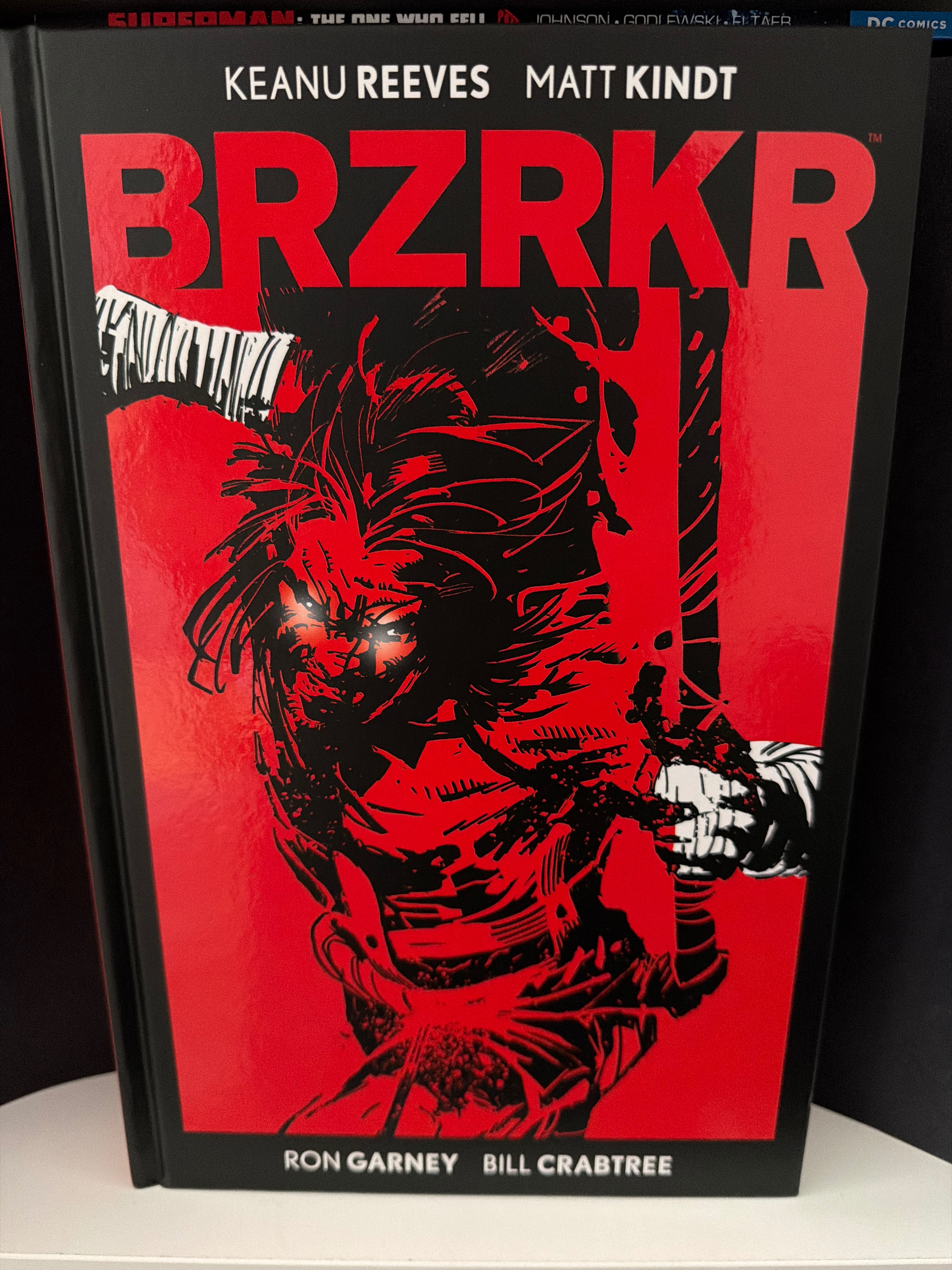
BRZRKR Deluxe Edition (2024)
10 May 2026 · Boom Studios
BRZRKR, published by Boom Studios in 2024, carries the weight of a campfire story before you even reach the first splash of violence. The book is large, heavy, and built for lingering, which is slightly ironic given that its title character tends to move through the world like a thrown engine block. Hold the deluxe edition and you are reminded that some comics are meant to be consumed as monthly jolts, while others ask to be re-read as objects, with the art allowed room to breathe and the blood allowed to dry on the page.
That physical presence matters because BRZRKR was always more than a celebrity curiosity, even if the name Keanu Reeves on a comic cover understandably made the wider world look twice. The series hit at a moment when the industry was still absorbing the shocks and strange opportunities of the early 2020s. The direct market had been rattled, crowdfunding had become impossible to ignore, and collectors were paying close attention to anything that felt like a genuine cultural event. Before its comic shop debut, BRZRKR became one of Kickstarter's most visible comics success stories, drawing a huge audience to a creator owned project from Boom Studios. By the time the first issue reached shelves in 2021, it already had the aura of something people wanted to witness for themselves.
A Boom Studios event in hardcover clothing
Boom Studios had spent years carving out a distinct place among American publishers, mixing sharp licensed work with creator owned books that could stand beside the biggest names in the shop. Something Is Killing the Children, Once and Future, and other modern Boom titles had helped convince readers that the publisher was not merely a strong alternative to Marvel and DC, but a destination for genre comics with real heat behind them. BRZRKR fitted that identity neatly, though its scale was unusual. It was violent, cinematic, mythic, and marketed with the confidence of a publisher that knew it had a conversation starter.
The 2024 deluxe edition gathers the core saga in a format suited to the book's blunt force spectacle. For collectors, that matters. Single issues have their own electricity, especially with a series that arrived with variant covers and a headline grabbing first issue, but a deluxe hardcover reframes the work. It turns a release schedule into a complete arc. It lets the reader see how the team controls escalation, how the brutality of the opening chapters folds into something sadder and stranger. On a shelf, it announces itself as the finished body rather than the scattered bones.
The timing is also part of its charm. In the years after the original series launched, BRZRKR expanded into one shots and related projects, while screen adaptation plans kept the title in the pop culture conversation. A live action film and an anime series were announced through Netflix, with Reeves attached, which added another layer of attention from readers who collect comics at the point where Hollywood interest and first appearances begin to overlap. The deluxe edition arrives as both a reading copy and a marker, a way of saying that the first major movement of this property now has a settled form.
The team behind the immortal
Reeves did not make the book alone, and the best way to understand BRZRKR is to look at the creative partnership rather than the marquee. Keanu Reeves brought the initial spark and the central silhouette, an immortal fighter with an uncanny resemblance to the actor himself, cursed with violence and searching for an end to his suffering. That premise could have remained a pitch deck image, handsome and hollow, without the comics makers around him.
Matt Kindt was the right writer to help shape it. Kindt has long been drawn to secrets, systems, memory, spy craft, and the emotional cost of hidden histories. In books such as Mind MGMT and Dept. H, he has shown a taste for puzzles that are less about cleverness than identity. With BRZRKR, Kindt takes a concept that could easily have been all velocity and gives it a spine of melancholy. The question is not simply how much damage one man can do. The question is what remains of a person who has spent thousands upon thousands of years being used as a weapon, a legend, a subject, and a problem.
Ron Garney gives that question its body. Garney's line has always had muscle, but in BRZRKR he leans into impact with ferocious clarity. Bodies slam through panels. Faces crumple. Arms swing with the awful certainty of machinery. Yet Garney is not only drawing gore. His Berzerker, usually referred to as B, carries himself with exhaustion even when surrounded by carnage. The posture matters as much as the punch. This is a man who has been worshipped, feared, studied, and deployed, and Garney lets you see the strain beneath the invulnerability.
Bill Crabtree's colors push the book toward heat and ache. The battles can feel scorched, almost feverish, but the quieter sequences have a different temperature, one that allows the reader to sit with memory and unease. Clem Robins, one of the great lettering presences in modern comics, keeps the whole thing readable even when the pages are loud with gunfire, screams, and mythic narration. Lettering can disappear when done well, and Robins has the old craftsman's gift of making chaos legible without making it polite.
Blood, memory and the shape of a curse
The story follows B, an immortal warrior who has been alive for roughly eighty thousand years. He cannot die in any ordinary sense, and his body can endure punishments that would turn others into rumor. In the modern day, he works with the United States government, sent into missions that no normal soldier could survive. In exchange, he hopes the scientists studying him can uncover the truth of his origin and, perhaps, offer him what he has been denied since the beginning: an ending.
That exchange gives the series its engine. B is not a superhero in the traditional sense, though he is plainly superhuman. He is closer to an ancient weapon that has somehow developed a conscience and a weariness the world refuses to honor. Around him are people who want different things from his impossible body. Some see military advantage. Some see a scientific miracle. Some see a man in pain. The tension between those views gives the book more staying power than its body count alone could provide.
The supporting cast is built around that tension, particularly the figures who try to understand B rather than merely aim him. The scenes of examination, conversation, and recollection are crucial because they slow the reader down. Without them, BRZRKR would risk becoming a beautifully drawn demolition reel. With them, the series becomes a tragedy about consent, memory, and the uses powerful institutions find for wounded people. It is not subtle in its violence, but its emotional center is quieter than the title suggests.
The past is just as important as the present. The series reaches back to B's earliest days, to the mystery of his birth and the burden placed on him before he had language for it. Myth rubs against military science. Ancient awe rubs against modern bureaucracy. The result is a comic that understands the appeal of seeing an immortal cut loose, while also asking what kind of prison immortality becomes when everyone else treats your life as a resource.
Readers responded first to the spectacle, naturally. The first issue sold in extraordinary numbers for an independent comic, helped by the Kickstarter campaign, the Reeves factor, and Boom's ability to turn a launch into an event. Yet the book's afterlife has been sustained by more than novelty. Fans who stayed with the twelve issue run found a story that became increasingly interested in grief and agency. Collectors, meanwhile, have had plenty to chase, from first printings to variants to the deluxe edition itself, which offers a cleaner way to keep the main story intact without losing the thrill of owning a modern phenomenon.
Where does BRZRKR sit in the wider canon? It is not trying to be a delicate literary miniature, and it would be false to treat it as one. Its lineage runs through action comics, immortal warrior stories, government conspiracy fiction, and the star image of Reeves, whose screen career has made him a surprisingly fitting figure for a character both lethal and sorrowful. What makes the comic interesting is the way those influences converge inside the machinery of the contemporary comics market. It is a creator owned blockbuster, a crowdfunding landmark, a Hollywood adjacent property, and a sincere attempt to use genre excess to talk about the desire for peace.
For collectors, that combination is hard to ignore. The deluxe edition is not only a convenient compilation. It is a snapshot of how comics can still create an event outside the old superhero houses, provided the idea is sharp, the presentation is strong, and the creative team can turn attention into pages that reward the reader. Garney's art alone benefits from the larger format, and the book's complete shape makes B's long march feel more mournful than it did in fragments.
If you missed BRZRKR in singles, the deluxe edition is the version that invites patience. Let it sit open. Watch how the violence gives way to fatigue, how the myth slowly tightens around the man at its center. The hook may be Keanu Reeves and an immortal warrior covered in blood, but the reason to keep the book is simpler and older. Somewhere inside all that ruin is a character asking whether a life without an end can still belong to him.